Why AI Wants to Be a King, Bitcoin Wants to Be a Commons
You’ve Been Trapped in a Cage You Didn’t Know Existed
Part I: The Scoreboard
If you want to understand where the world is going, you have to look at the scoreboard.
On one side, you have Artificial Intelligence. Every headline tells you it’s going to “revolutionize everything.” TIME Magazine just named the “Architects of AI” Person of the Year. And sure, it will revolutionize everything. But look at who’s doing the revolutionizing. It’s three guys in Patagonia vests who already own the internet and are now building the machine that will make the internet look quaint. Sam Altman didn’t amass a $100 billion war chest because he wants to “benefit humanity.” He wants to be the man who rents humanity its brain.
On the other side, you have Bitcoin. It doesn’t have a headquarters. It doesn’t have a CEO. It doesn’t have a PR team explaining why this round of layoffs is actually good for you. And yet, it’s the only asset class that has survived 15 years of government hostility without asking for a bailout, a subsidy, or a seat at the Davos buffet.
One technology is designed to make the powerful more powerful. The other is designed to make power irrelevant.
But to understand why that matters, you have to understand the cage you’ve been living in your whole life.
Part II: The Invisible Cage
You can choose your friends. You can choose your religion. You can choose your politics, your partner, your pronouns.
But for 5,000 years, you could not choose your money.
Money is the universal solvent. It dissolves every barrier you thought protected you. It permeates every class, every country, every ideology. It dictates the life of the pauper just as rigidly as it dictates the life of the prince.
The beggar on the street corner? He’s playing the money game. The coins in his cup buy less bread every year, and he didn’t vote for that.
Elon Musk? He’s playing the same game. Richest man in the world, and his bank can still freeze his account if he tweets the wrong thing at the wrong bureaucrat.
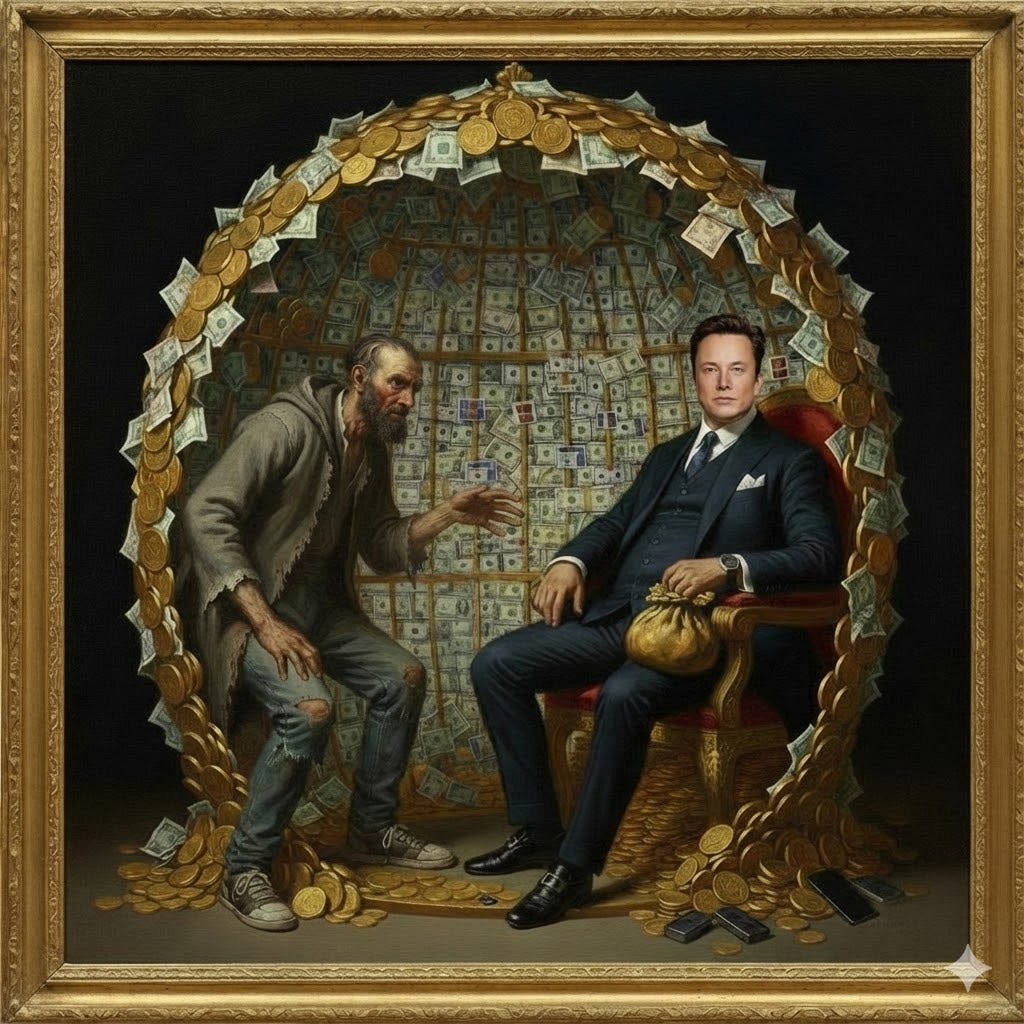
Different seats. Same cage.
The Mandatory Sport
Until 2009, money was a mandatory participation sport. You didn’t sign up. You didn’t consent. You were born into it, and you were going to die in it.
If you were poor, the system inflated your savings away. Every year, the dollar in your pocket buys a little less. Not because you did anything wrong, but because the people who control the money needed to pay for wars, bailouts, and vote-buying schemes that had nothing to do with you. You were taxed without even seeing a tax bill.
If you were rich, the system surveilled your every transaction and held a knife to your throat. Your wealth wasn’t really yours; it was just a number in a bank’s database, regulated by a government, and subject to seizure the moment you became inconvenient. Ask any Russian oligarch how “ownership” works when you piss off the wrong people.
There was no exit. No opt-out. No conscientious objector status.
You played by the King’s rules, or you didn’t play at all. And since “not playing” meant starving in a ditch, you played.
The Great Leveler
We’re taught that money divides us. The rich have it; the poor don’t. Class warfare. Eat the rich. The whole script.
But here’s the twist: in a fiat system, money doesn’t divide us. It binds us together in a shared tragedy.
The Beggar’s Tragedy: Death by Debasement
The beggar suffers because the money in his pocket is melting. Not metaphorically, literally. The government prints trillions to bail out banks, and the cost of his sandwich goes up 15%. He didn’t get a bailout. He got the bill.
He’s running on a treadmill that keeps speeding up. He can’t store the fruit of his labor because the container, the dollar, has a hole in the bottom. Work harder, save more, fall further behind. That’s not a bug. That’s the design.
The Billionaire’s Tragedy: Death by Permission
The billionaire suffers because he has the money but not the control. His “wealth” is just an entry in someone else’s database. A bank he doesn’t own. A jurisdiction he doesn’t control. A system that can freeze him out with a single phone call.
He’s rich, sure, but only as long as he’s obedient. Only as long as he doesn’t annoy the wrong senator, fund the wrong cause, or end up on the wrong side of the news cycle. His sovereignty is a loan, callable at any time.
PayPal can close his account. Visa can cut him off. The Treasury Department can add him to a list, and suddenly his billions are just digits he can look at but not touch.
Both are trapped. One is trapped by poverty. The other is trapped by permission. The cage looks different from the inside, but it’s the same cage.
This is the water we’ve been swimming in for so long that we forgot it was wet.
And now, into this ancient system, comes a new predator.
Part III: The AI Trap
AI is what economists call a “capital-biased” technology. That’s fancy talk for: “If you already have money, you win. If you work for a living, good luck.”
Here’s the physics of it:
1. Data is the Moat
To build a good AI, you need all the data in the world. Every email you ever sent. Every search you were embarrassed to type. Every photo you uploaded “privately.” Google has it. Meta has it. Microsoft has it. You gave it to them for free, and now they’re training your replacement with it. Thanks for your contribution.
2. Compute is the Key
You can’t build an AI in your garage anymore. Those days ended around 2019. Now you need a warehouse full of Nvidia H100 chips that cost $30,000 a pop, and a power bill that looks like a small country’s GDP. The entry ticket to this casino is $10 billion, minimum. Only the monopolies already at the table can afford to play.
3. The Rich Get Richer
As AI gets better, it replaces labor. The wages that used to go to writers, coders, artists, and drivers now go to the model’s owners. The productivity gains flow up to shareholders, not down to workers. You become more efficient at making someone else wealthy.
This isn’t a competition. This is Highlander. There can be only one. And when the sword fight is over, the winner doesn’t owe you a damn thing.
The giants aren’t fighting to serve you better. They’re fighting to become the only game in town. And once they control the algorithm, they become the capricious gatekeepers of the entire economy. Your job, your reach, your income, all of it flows through their tollbooth.
What They’re Actually Fighting Over
Here’s what they don’t put in the press release.
AI doesn’t run on dreams. It runs on electricity. Massive, city-sized amounts of electricity. A single hyperscale data center drinks as much power as 100,000 households. By 2030, these things will consume half of all new electricity demand in America. Your power bill is going up to subsidize the machine that’s going to take your job. Quite a deal.
And right now, the only thing standing between Big Tech and all that juice is a patchwork of state regulators, local utility boards, and environmental reviews. That’s the real fight. The “woke AI” stuff in the executive orders? That’s the magician’s left hand. The right hand is reaching for the power grid.
They don’t need you to believe the story. They just need you to watch it long enough for the permits to clear.
So let’s tally up the cage you’re in now:
You’re trapped in a money system that either inflates your savings away or freezes them if you misbehave. And now, on top of that, a new layer of control is being built, one where a handful of companies own the algorithms that decide who gets hired, who gets seen, who gets heard, and who gets to participate in the economy at all.
The beggar’s treadmill just got faster.
The billionaire’s leash just got shorter.
The cage just got smaller.
Part IV: The Bitcoin Alternative
This is why Bitcoin hit the world like a thunderclap.
It’s not because the number goes up. It’s not because of the laser eyes, the memes, or the Lamborghini dreams.
It’s because, for the first time in 5,000 years of monetary history, someone built an exit door .
Bitcoin is structurally allergic to monopolies. It’s a “monopoly without a monopolist, a phrase that will melt an economist’s brain if you let them sit with it long enough.
No Moats Allowed
The Bitcoin ledger is open. Anyone can read it. The code is open source. Anyone can audit it. The mining network is permissionless. Anyone can join it. There’s no “proprietary data” that gives one miner a permanent advantage over another. No one can lock you out because you didn’t go to the right school or know the right people.
Competition Protects the User
The AI world , is when Google wins, you get surveilled. Your data gets harvested. Your attention gets sold. The better they get, the worse it is for you.
T he Bitcoin is world, when miners compete, the network gets more secure for you . The hash rate goes up. The difficulty adjusts. The fortress gets stronger. The competition doesn’t build a monopoly; it creates a shield around your savings.
The Rent-Seekers Starve
The entire point of Bitcoin is to remove the “trusted third party.” That third party, the bank, the payment processor, the Fed, the guy in the suit who tells you your money is “safe” while lending it out ten times over, is usually a monopoly extracting rent from your labor. Bitcoin cuts them out. Not by asking nicely. By making them unnecessary.
This isn’t Highlander. This is the opposite. It’s a system where the protocol doesn’t care if you’re BlackRock or a kid in El Salvador. It treats you exactly the same. The only question it asks: Do you have the keys or don’t you?
The Exit Door
For the beggar: Bitcoin cannot be debased. No politician, no central banker, no “emergency” session of Congress can print more of it. The 21 million cap is enforced by math, not promises. The beggar’s crust of bread is protected by the same law of scarcity that protects a nation-state’s treasury. For once, the little guy’s savings aren’t a sacrificial lamb for the next bailout.
For the billionaire: Bitcoin cannot be seized if you hold the keys. Not “cannot be seized unless a judge orders it.” Not “cannot be seized except in extraordinary circumstances.” Cannot be seized. The network doesn’t know who you are. It doesn’t care. It just verifies signatures. No bank to freeze. No jurisdiction to pressure. Actual sovereignty, not the theatrical kind.
For the first time in history, the beggar and the billionaire have access to the same escape hatch.
Part V: The Great Divergence
We are living through a species-level shift, and most people are watching the wrong screen.

Two economies are emerging. Two paths. Two futures.
The AI Economy is a feudal system.
You will live on the King’s land, that’s the platform. You will use the King’s tools, that’s the subscription. You will pay the King a tithe every month, and if you displease him, he will banish you from the kingdom with a terms-of-service update at 3 AM on a Tuesday. Your data, your content, your digital life, none of it is yours. It never was. You just didn’t read the fine print.
Don’t like it? Good luck building your own $50 billion data center.
The AI economy concentrates wealth and power into the hands of a few “Architects” who get their picture on the cover of TIME. Everyone else gets to compete for the scraps or wait for the Universal Basic Income check that will keep you docile enough not to ask questions.
This is the cage, upgraded. Smaller. Smarter. Harder to see.
The Bitcoin Economy is a free market.
Not the fake “free market” where the big boys get bailouts, and you get inflation. A real one. A system where you own your own money, you hold your own keys, and no King can debase your savings to fund his wars, his data centers, or his Mars colony vanity project.
It doesn’t care if you went to Stanford. It doesn’t care if Peter Thiel returns your calls. It doesn’t care about your pronouns, your politics, or your pedigree. It only cares whether you’re willing to take responsibility for your own financial sovereignty.
One path leads to a world where a few people own everything and everyone else gets a monthly stipend and a pat on the head.
The other path leads to a world where ownership is distributed to anyone willing to do the work.
Part VI: The Door
For the last century, if you wanted to participate in modern society, buy food, pay rent, receive a paycheck, you had to use the government’s money. You had to accept the inflation. You had to accept the surveillance. You had to accept that your financial life was one “suspicious activity report” away from being frozen.
The social contract was simple: We control the money. You use it. Shut up and be grateful.
Now, for the first time, you have a choice.
You can stay in the cage. Keep using money that melts in your pocket and requires someone else’s permission to spend. Keep hoping the next election will fix things, the next Fed chairman will be responsible, the next crisis won’t wipe out your savings. Keep watching the AI overlords build their Death Star and praying they’ll let you live on it.
Or you can opt out.
You can use money that doesn’t leak. Money that doesn’t ask. Money that doesn’t care if you’re a billionaire or a beggar, a saint or a sinner, a citizen or an exile.
You can’t stop the monopolies from building their machine. That fight is above your pay grade.
But you don’t have to live on it.
The cage is still there. The beggar is still hungry tonight. The billionaire is still being watched.
But the door has been unlocked since January 3, 2009.
Most people haven’t noticed yet.
The ones who have?
They walked through it.
Grab your keys. Find the exit.

Leave a comment