The Four Horsemen Just Stepped in Digital Dog Shit
How Agentic Payments Are About to Unwind Thirty Years of Surveillance Capitalism
By Brian Connelly (with apologies to Scott Galloway, whose lawyers are welcome to call)
In 2017, the esteemed Scott Galloway wrote a wonderful book unmasking the internet monopolies of the day. discussed how Amazon, Google, Facebook, and Apple turned you from being a customer into being a product.
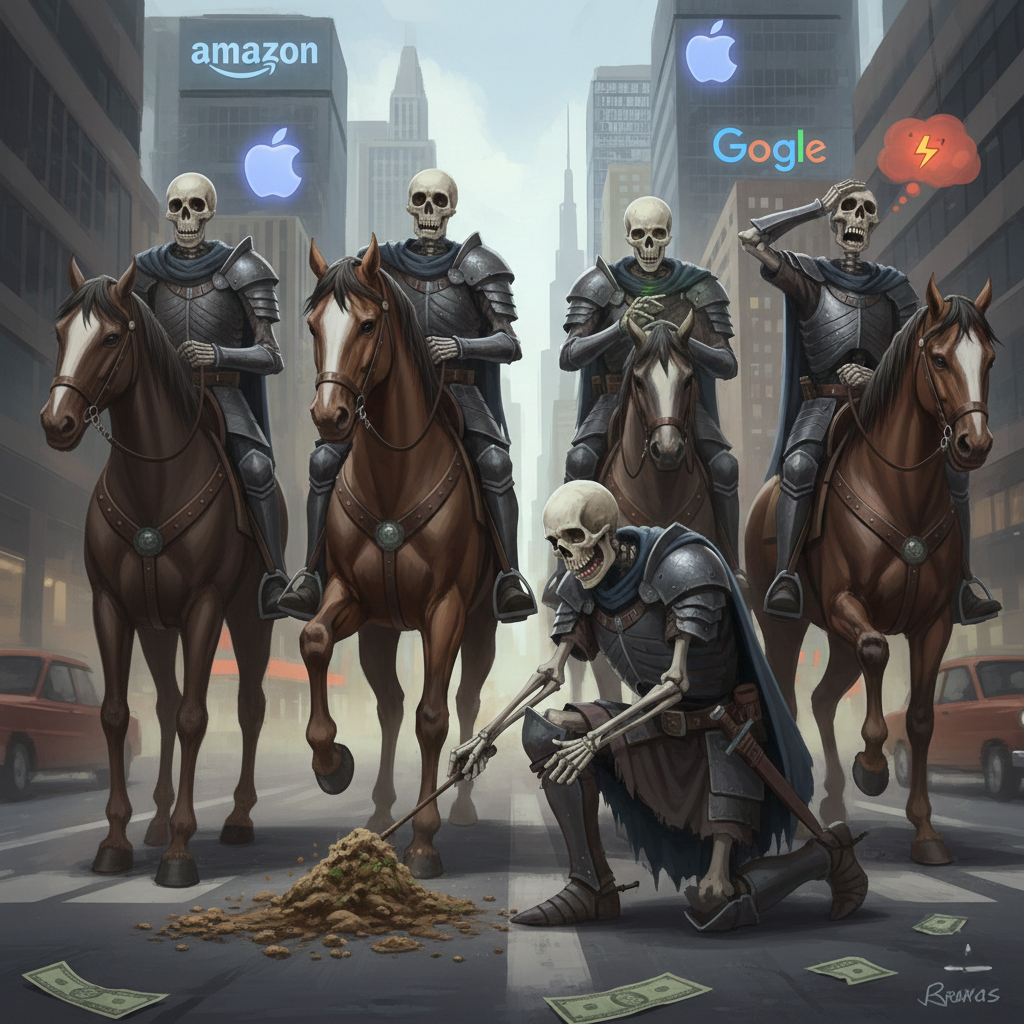
You can’t pay for things in small amounts, so you’ll pay with your soul instead.
That’s it. That’s the whole trick.
The credit card industry’s fee structure, thirty cents plus a percentage, made micropayments mathematically impossible in 1995. So when you wanted to read a newspaper article, you couldn’t pay a nickel. Instead, you got surveillance capitalism: a business model where you are the product, your attention is auctioned in real time, and democracy itself becomes a rounding error in the Q3 earnings call.
The Four Horsemen didn’t create this system. They just rode it harder than anyone else, whipping the horse until it bled Super Bowl ads and congressional subpoenas.
But here’s the thing about that, the horses live, but the riders: they die.
The Trust Tax: A Thirty-Year Shakedown
Let me introduce you to a concept the Horsemen pray you never understand: the Trust Tax.
Every time you interact online, you pay an invisible toll. Not in dollars, in friction, data, and dignity.
- Google charges you by harvesting every search, email, and location ping to build a psychological profile so accurate it knows you’re pregnant before your mother does.
- Amazon charges you by making their platform so frictionless that you stopped price-comparing in 2012, and now you’re paying 15% more for everything while Jeff Bezos builds a clock inside a mountain like a Bond villain with a Prime membership.
- Facebook charges you by addicting your teenage daughter to a dopamine slot machine that knows exactly how to make her hate her body, then runs internal studies proving this, then buries them.
- Apple charges you 30% on every app transaction for the privilege of existing in their walled garden, a “tax” that would make Louis XIV blush if he could figure out how to unlock his iPhone with Face ID.
This isn’t capitalism. It’s feudalism with a one-clickuser interface.
The Trust Tax exists because in 1995, you couldn’t pay ten cents for an article. So publishers had two choices: go bankrupt, or let Google monetize their content through ads while keeping most of the revenue. Guess which one they picked.
Enter the Machines (With Wallets)
Here’s where it gets interesting, and by “interesting,” I mean “existentially terrifying if you’re a Horseman.”
They can’t pass KYC.
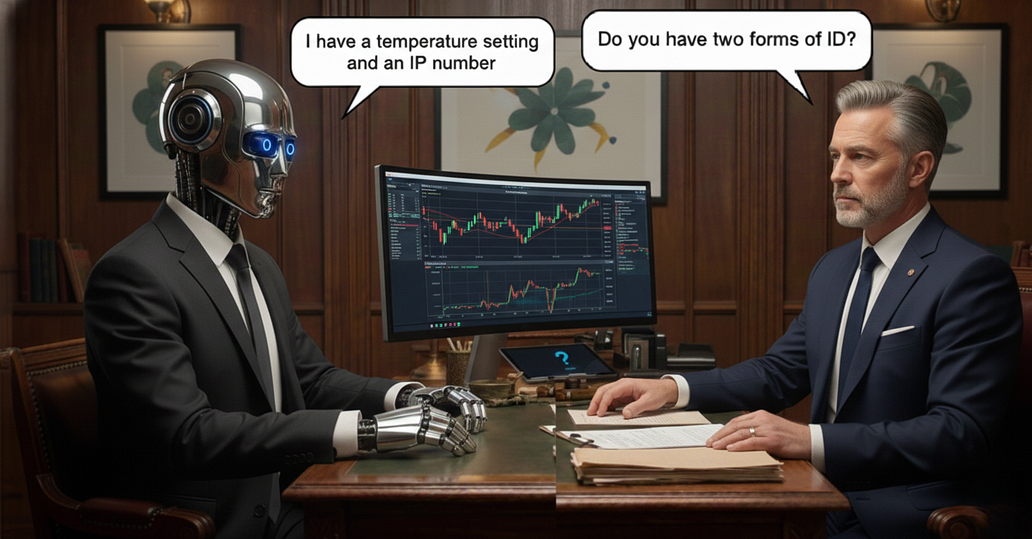
Credit card minimums make this impossible. You cannot process a $0.0001 transaction when Visa takes 30 cents off the top.
So what do the agents use?
Bitcoin: The Boring Revolution
I know, I know. You hear “Bitcoin,” and you think laser eyes, Lamborghinis, and guys named Chad telling you to “have fun staying poor.”
Forget that circus.
No bank. No KYC. No thirty-cent minimum. No surveillance.
A protocol called L402 combines payment with authentication. When an agent needs access to an API, it doesn’t present a stolen API key tethered to some human’s credit card. It just… pays. Instantly. Then it gets access. The payment is the permission.
Read that again. Then think about what it means for companies whose entire business model requires humans to be in the loop, logged in, tracked, profiled, and monetized.
How Each Horseman Gets Kicked in the Teeth
Let’s get specific. Let’s get mean.
Google: The Ad-Pocalypse
Google’s dominance rests on one ugly truth: publishers couldn’t charge readers directly, so they had to monetize through ads. Google became the middleman, skimming billions while journalism collapsed into clickbait hellscapes optimized for engagement rather than truth.
Agentic payments change the math.
If a publisher can charge an AI agent $0.001 to access an article, no login, no tracking, no subscription, they don’t need Google’s ad network. The content gets funded directly. The user (or their agent) gets information without surveillance.
Amazon: The Friction Trap
Because in an Agentic Economy, your AI agent doesn’t need Amazon’s stored credentials. It carries its own Lightning wallet. Every merchant on Earth becomes “one click” when the agent can pay anyone instantly.
Amazon’s warehouse network is still formidable. But their customer lock-in? That evaporates when payment friction drops to zero everywhere. You’re not choosing Amazon because they’re cheaper; you’re choosing them because typing your card number somewhere else feels like filing taxes.
Remove that friction advantage, and suddenly Amazon is just… a big store. With unionized workers. And rising costs. And a CEO who looks increasingly like he’s cosplaying as Lex Luthor.
Meta: The Privacy Vampire
Facebook’s value proposition to advertisers is simple: “We know everything about everyone, and we’ll sell you access to their eyeballs.”
This works because users can’t pay for the service directly. A micropayment model, paying a tenth of a cent per post viewed, a hundredth of a cent per like, would let users opt out of surveillance entirely.
“But users won’t pay!” the Meta apologists cry.
Apple: The Gatekeeper’s Toll
Apple’s App Store takes 30% of every transaction. Developers hate it. Regulators are circling. But what choice do developers have? The walled garden is the only garden.
Except Lightning payments don’t go through the App Store. An app that monetizes through direct micropayments, tips, unlocks, subscriptions paid in sats, bypasses Apple’s toll entirely.
The Convergence That Actually Matters
Bitcoin miners who spent a decade building energy-to-computation infrastructure are now pivoting to AI.
Companies like Hut 8 and Core Scientific control exactly what the Horsemen don’t: massive, stranded power capacity and the operational expertise to manage it.
These aren’t crypto bros pivoting to chase hype. These are the people who figured out how to convert energy into unforgeable digital scarcity at scale. Now they’re converting energy into intelligence.
The same infrastructure. The same arbitrage on power costs. The same locations near cheap electricity that traditional data centers ignored.
This is not a pivot away from Bitcoin. It’s an extension of the thesis. Energy becomes computation. Computation becomes intelligence. Intelligence transacts on permissionless rails.
The Agentic Economy, built on Bitcoin, eliminates that tax.
The Uncomfortable Question
I can hear the objection already: “This sounds like techno-utopian nonsense. The Horsemen have trillions of dollars, armies of lobbyists, and regulatory capture so complete they write the laws that govern them.”
But let me ask you something: in 1994, did Sears think Amazon was a threat? Did Blockbuster lose sleep over Netflix? Did the entire newspaper industry convene an emergency meeting about Craigslist?
Incumbents don’t die because someone outcompetes them head-on. They die because the game changes, and they’re still playing by the old rules.
The Agentic Economy changes the conditions.
When machines can pay machines in milliseconds for fractions of a cent without human identity or surveillance, the Horsemen’s moats don’t just shrink. They become irrelevant.
The Bottom Line
The Four Horsemen of the Apocalypse built their dominion on a bug in the financial system: you couldn’t pay small amounts, so you paid with data instead.
Bitcoin fixes this.
The Agentic Economy doesn’t need Google to broker attention. It doesn’t need Amazon to store credentials. It doesn’t need Facebook to monetize relationships. It doesn’t need Apple’s permission to transact.
It just needs permissionless rails. And those rails now exist.
The Horsemen are still powerful. Still rich. Still arrogant.
But they’ve never faced an enemy that doesn’t want to beat them; it just wants to ignore them.
That’s the kick in the pants.
Oldies but goodies
CBDCs: The Horsemen 2.0 (Now With Badges)
So the advertising model dies. The Four Horsemen can no longer afford to surveil you for free. Champagne corks pop in privacy advocate basements worldwide.
Not so fast, sunshine.
Let me explain CBDCs in terms even a congressman could understand:
It’s money. But the government can see every transaction. And turn it off.
That’s it. That’s the product.
China’s already doing it. The digital yuan enables the People’s Bank of China to monitor every purchase in real time. Buy too much alcohol? Social credit ding. Donate to the wrong cause? Wallet frozen. Try to leave the country while your score is low? Good luck buying a train ticket, dissident.
“But that’s China,” you say, adjusting your Patagonia vest and sipping your oat milk latte. “We have rights .”
Do we? Let’s review.
In 2022, the Canadian government froze the bank accounts of truckers who protested COVID policies. Not convicted criminals. Not terrorists. Truckers who honked too much. Their crowdfunding donations, completely legal, were seized. GoFundMe folded faster than a lawn chair in a hurricane.
No trial. No due process. Just… frozen. Because they could.
Now imagine that capability baked into the money itself.
The Features They Don’t Put in the Brochure
The Federal Reserve and European Central Bank are “researching” CBDCs with the same energy a teenager “researches” their crush’s Instagram at 2 AM. They want this. Badly.
Here’s what a CBDC enables:
Programmable Money: Your dollars come with conditions. The government can set expiration dates (“use it or lose it” stimulus), restrict categories (“no guns, no crypto, no donations to unapproved organizations”), or adjust based on your behavior.
Think of it as a gift card to America. Terms and conditions apply. Management reserves the right to revoke at any time for any reason.
The IRS’s $80 billion budget increase suddenly makes more sense, doesn’t it? They’re not hiring 87,000 agents to audit billionaires. They’re building the rails for automated extraction.
Negative Interest Rates That Actually Work. Central banks have wanted negative interest rates for years, charging you to save money so you’ll spend it instead. But with cash, you can just withdraw your savings and stuff it in a mattress.
Social Credit, American Style We won’t call it “social credit.” That’s too Chinese. We’ll call it “financial wellness scores” or “responsible spending indicators” or some other HR-approved euphemism.
But when your CBDC wallet gets flagged because you bought a gun, donated to a disfavored political candidate, or purchased more than your carbon allowance of beef this month, you’ll understand: it’s the same system with better marketing.
The Four Horsemen Become the Four Contractors
Here’s where the Venn diagram gets ugly.
Who has the infrastructure to process billions of transactions in real-time? Who has the facial recognition, the behavioral modeling, the identity verification? Who’s already embedded so deeply in government systems that the line between public and private is a polite fiction?
The Horsemen.
Same horses. New rider. Bigger whip.
Amazon Web Services already hosts classified CIA data. Google’s AI is embedded in Pentagon systems. Apple has your face, your fingerprints, and your health data. Facebook knows your social graph better than you do.
“But We Need Digital Dollars for Innovation!”
This is the part where some McKinsey consultant in a fleece vest explains that CBDCs will “promote financial inclusion” and “reduce friction in payments.”
Let me translate from Consultant to English:
“Financial inclusion” = We’ll finally be able to surveil poor people as effectively as we surveil everyone else. Those pesky cash transactions in underbanked communities have been a real blind spot for our behavioral models.
Every “benefit” of CBDCs can be achieved with existing technology. Faster payments? We have Venmo, Zelle, and FedNow. Financial inclusion? We have prepaid cards and mobile banking. Cross-border efficiency? We have… well, we have Bitcoin, but let’s not tell the Fed.
That’s not a side effect. That’s the point.
The Timeline Is Faster Than You Think
“This is years away,” you tell yourself. “I’ll worry about it later.”
The digital yuan has over 260 million users. The European Central Bank is targeting 2027 for a digital euro. The Bank of England is “consulting” on a digital pound they’ve already named “Britcoin” because apparently someone in government has a sense of humor.
And the Fed? They’re “studying” the issue while every major commercial bank builds CBDC-ready infrastructure. JPMorgan didn’t spend hundreds of millions on blockchain technology because Jamie Dimon loves decentralization. They’re building the toll booths for the new highway.
Exit While the Door Is Open
Here’s the thing about surveillance capitalism: you could always kind of opt out. Use cash. Don’t use social media. Buy a flip phone. Live like a weirdo, but live free.
CBDCs close that door.
When the money itself is the surveillance tool, there’s no opting out. Every transaction, every purchase, every financial relationship, all of it visible, all of it controllable, all of it subject to rules you didn’t write and can’t change.
Unless you have an exit.
Bitcoin doesn’t ask permission. No government issued it. No corporation controls it. No committee can reprogram it. The rules are the rules, enforced by math, not policy.
Lightning doesn’t ask permission. Your AI agent doesn’t need a CBDC wallet that requires social credit. It needs a Lightning node and some sats.
Self-custody doesn’t ask permission. Your keys, your coins. Not “your coins unless we decide otherwise.” Not “your coins subject to terms and conditions.” Yours.
The Agentic Economy can run on CBDCs. The Horsemen would love that, same surveillance, same control, just with robots doing the shopping.
Or it can run on Bitcoin. Permissionless. Private. Free.
The choice is being made right now, while most people are still arguing about whether crypto is “real money.”
By the time they figure it out, the door may be closed.
The Punchline
CBDCs are the same logic, extended.
If money can be programmable, it will be programmed. If transactions can be surveilled, they will be surveilled. If behavior can be controlled through financial access, it will be controlled.
The only thing that breaks the pattern is an alternative that doesn’t care about incentives because it doesn’t have a decision-maker. A system that runs on rules, not rulers.
The Horsemen are about to get kicked in the teeth by agentic payments.
The question is whether the boot that replaces them belongs to a free market or to a government that finally figured out how to make the boot programmable.
“When you can’t opt out of the money, you can’t opt out of anything.” Said someone who probably should have bought Bitcoin earlier.
Brian Connelly is a technology consultant, Bitcoin educator, and author of “How to Keep Your Bitcoin Alive and Well.” He has been ignored by the Four Horsemen for over a decade, which he considers a badge of honor.

Leave a comment