or why nobody explained ‘mining’ to you plainly
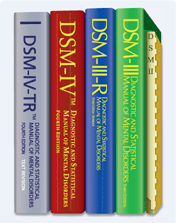
When I started doing clinical social work in 1979, we carried around a booklet called the DSM-II, the Diagnostic and Statistical Manual of Mental Disorders, Second Edition. It was 134 pages sprial bound and yellow, it read like a philosophical field guide. It was written to help therapists think. Not to prove anything to anyone, just to help the person in the room do better work with the person sitting across from them.
Then the insurance companies showed up.
By the time the DSM-III landed, it was 494 pages with 265 diagnoses. The DSM wasn’t growing because the human condition got more complicated. It was growing because relationships needed to be quantified. What had been a corrective relationship between the client and therapist became a billing event between the provider and the payer. Today the DSM is over a thousand pages with more than 300 diagnoses. Critics say we’ve turned everyday sadness and childhood temper tantrums into billable, thousand-page, certified medical conditions.
The point is not that the DSM is bad. The point is that more words are not always helpful for everyone. Sometimes language grows to serve the people inside a system, not the people trying to understand it from outside.
Bitcoin has exactly this problem.
The technology is not that complicated. But the vocabulary around it was built by engineers for engineers, and over the years it has calcified into a barrier that keeps ordinary people from understanding something that was literally designed for them.
Take the word “mining.”

You hear it and you think of pickaxes and gold veins and someone pulling something valuable out of the ground. Then someone tells you Bitcoin mining is “computers solving complex mathematical algorithms” and you’re more confused than you were before you asked. That’s not your fault. The word was never meant to describe what’s actually happening. It was a metaphor that stuck because it rhymed nicely with “coin,” which is also misleading, but that’s another chapter.
Here is what mining actually is.
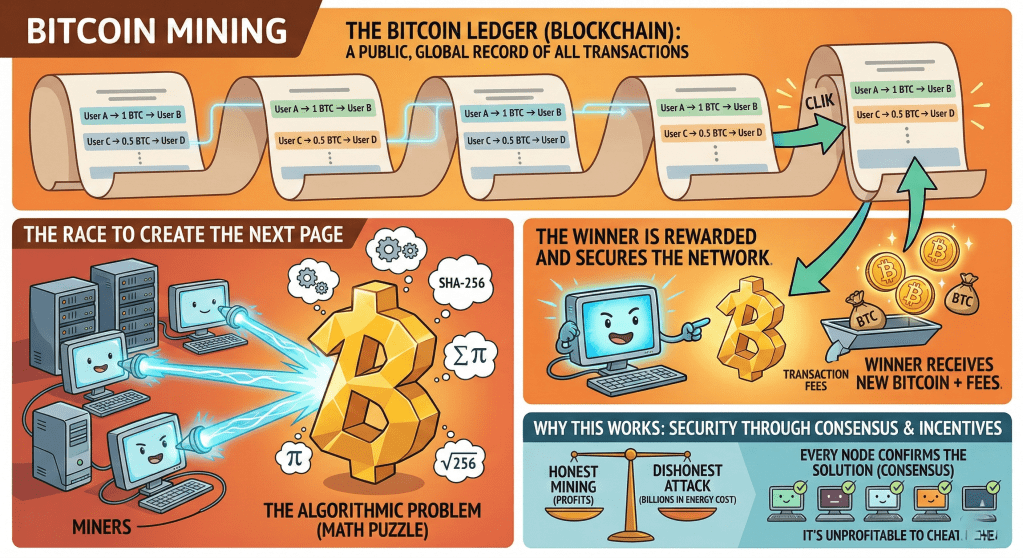
Bitcoin runs on a ledger. A global, publicly visible record of who paid what to whom. About every ten minutes, that ledger needs a new page. The computers we call “miners” are competing with each other to earn the right to add that page. They do this by drilling into an algorithmic problem the network sets for them. Not drilling into the earth, drilling into math. The first one to solve it adds the new page, the network confirms everything checks out, and that miner gets paid in Bitcoin.
Then the race starts over.
That’s it. Mining is bookkeeping that nobody can tamper with, performed by computers that get rewarded for doing it honestly. No hash rates. No nonces. No block headers. Just a race, a ledger, and a reward.
If that just made sense to you, good. It was supposed to. And if you’re wondering why nobody explained it to you this way before, you’re asking the right question.
I spent thirty years as a Systems Architect and Strategic Consultant for Fortune 500 companies, translating complex systems into plain language for people who had better things to do than learn jargon. Before that, I did clinical social work, where I learned that how you say something matters at least as much as what you’re saying. When I came to Bitcoin, I found brilliant resources written by brilliant people who had forgotten what it was like not to understand this stuff yet.
If you’ve been curious about Bitcoin but felt like the conversation wasn’t built for you, you were right. It wasn’t. This series is.
Or
How to Keep Your Bitcoin Alive and Well does for every piece of Bitcoin jargon what this article just did for mining. Plain language, a little humor, and enough respect for the reader to assume they can understand anything if someone just explains it honestly.
Tune in next week when we talk about “Proof-of-Work” and why it makes Bitcoin different from everything else.
If you’re ready to jump into the bloody details, have the time, and aren’t frightened off by the language, I recommend Bitcoin and Cryptocurrency Technologies, which is detailed and academic. The text may be available as a free download somewhere. Google it.