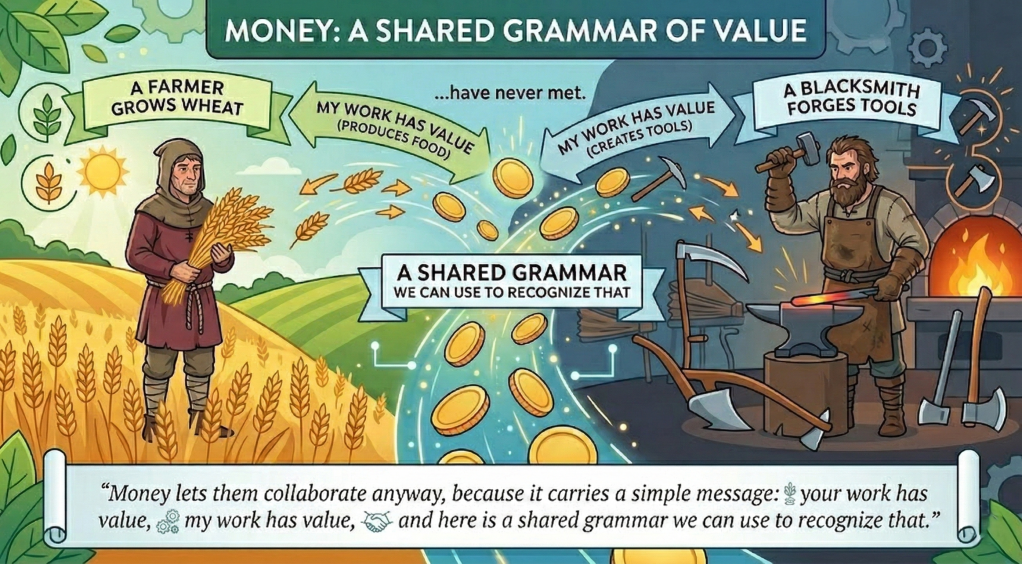
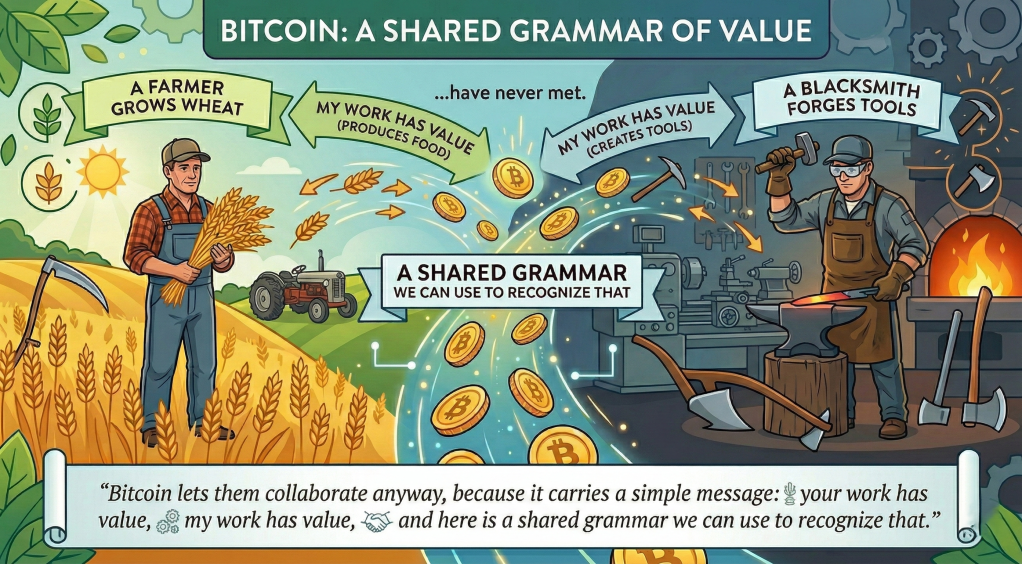
Money is a cooperative technology. That’s what it was built to do. Before it was a commodity, before it was a policy instrument, before it was a weapon, money was the language that let strangers work together without needing to trust each other personally. A farmer grows wheat. A blacksmith forges tools. They have never met. Money lets them collaborate anyway, because it carries a simple message: your work has value, my work has value, and here is a shared grammar we can use to recognize that.
This is so fundamental that we forget it. We think of money as something you earn, spend, save, invest. Something that moves between people. But before it moves, it speaks. It says: I see what you did, and it mattered.
The earliest money we know about wasn’t coins. It was ledgers. Clay tablets in Mesopotamia, roughly five thousand years ago, recording obligations within a community. This farmer contributed grain to the storehouse. This builder repaired the canal. The tablet wasn’t tracking exchanges between adversaries. It was tracking contributions among participants in a shared project called “we all survive this year.”
Money was the memory of cooperation. That’s all it was.
So what happened?
Somewhere along the way, we stopped saying “cooperation” and started saying “transaction.” And that shift wasn’t cosmetic. It was architectural.
Feel the word. Trans-action. Action across a boundary. The moment you frame money as transactional, you’ve introduced a boundary between the participants. Now there are two sides. Now there’s a buyer and a seller. Now someone got the better deal and someone didn’t. Now there’s information worth hiding, because if I know something you don’t about what we’re exchanging, I win.
The entire vocabulary of commerce lives inside this frame. Leverage. Arbitrage. Competitive advantage. Information edge. Proprietary data. Trade secrets. None of these words exist in a cooperative grammar. Every one of them is native to a transactional one.
And the transactional frame didn’t emerge because people got greedier. It emerged because someone captured the ledger.
Go back to those Sumerian clay tablets. The temple controlled them. And the moment a third party controls the memory of cooperation, that third party can edit the memory. They can add a line that says the temple is owed a percentage of every contribution. Not because the temple grew grain or dug canals, but because the temple keeps the record.
The temple becomes the first intermediary. And the intermediary needs a justification. So the framing shifts. It is no longer “we are all contributing to a shared project.” It becomes “you owe the temple, and the temple owes you, and these are separate accounts.” Two sides. A boundary. A transaction.
Cooperation doesn’t need a middleman. Transactions do. So the middleman reframes cooperation as transaction, and suddenly the middleman is essential.
Every monetary system since has repeated this move. Rome puts Caesar’s face on the coins, routing every exchange through imperial authority. Medieval Europe routes commerce through the Church and the crown. The Bank of England. The Federal Reserve. Same architecture across five millennia. A third party inserts itself into the cooperative language, reframes it as transactional, and extracts rent from the reframing.
And here is the part that matters: every time the ledger keeper gains control, secrecy follows. Not as corruption. As structure.
The temple priests knew things about the community’s obligations that the community didn’t know about itself. That information asymmetry was the source of their power. Every intermediary since has operated on the same principle. Your bank knows your balance, your debt, your payment history, your risk profile. You don’t know theirs. The asymmetry isn’t a flaw. It’s the product.
Once the grammar is transactional, secrecy becomes rational. You’d be a fool to show your hand in a negotiation. You never reveal your cost basis. You never let the other side know how badly you need the deal. The language itself teaches you to hide.
And this is where the story connects to the headlines.
Jeffrey Epstein sat exactly where the temple priests sat. At the ledger. He knew who owed what to whom, who had been where, who had done what. He was the keeper of a private record of obligations, and that record gave him power over everyone in it. The powerful came to his table for the same reasons powerful people have always come to such tables: access, introductions, money, favors. The transactional grammar that governs our world made his position not just possible but inevitable.
People want to call Epstein an aberration. A monster who broke the system. But the system wasn’t broken. The secrecy didn’t emerge because people are bad, although bad people are certainly attracted to this sort of arrangement. The secrecy emerged because the structure demands it. Epstein didn’t break the system. He industrialized it.
Before Epstein, the same output was produced in smaller batches. Royal courts. Gentlemen’s clubs. Private salons where favors were traded and secrets accumulated by whoever controlled the guest list. The product was always the same: leveraged secrecy in a transactional grammar. Epstein built the factory.
And here is the question that should keep us up at night. Not “how do we prevent the next Epstein?” but “what kind of monetary language keeps producing them?”
Because the answer to the first question is always the same. More regulation. More oversight. More committees. More inspectors. And every single time, the people who control the transactional language co-opt the reformers. They hire the regulators. They fund the campaigns of the overseers. They donate to the institutions that are supposed to hold them accountable. This is not conspiracy. This is the language working as designed. In a transactional grammar, the most fluent speaker always wins.
The answer to the second question is different. It asks us to look at the grammar itself.
What if the language of money could return to its cooperative roots? Not through legislation or moral improvement, but through design?
This is what Bitcoin does. And it does it in a way that maps directly onto the problem we’ve been tracing.
Bitcoin removes the intermediary from the ledger. There is no temple. There is no priest. There is no third party who controls the memory and edits it in their own favor. The record of who contributed what is shared, public, and immutable. No one can add a line that says they are owed a cut for the privilege of keeping score.
Without an intermediary extracting rent, there is no structural need to reframe cooperation as transaction. Without a transactional frame, there is no structural incentive for secrecy. The grammar changes, and with it, the kind of sentences that can be composed.
You cannot build an Epstein operation on a transparent ledger. Not because the technology prevents crime through force, but because the language no longer supports the necessary constructions. The dark rooms where leveraged secrets accumulate simply don’t exist in a grammar that records everything openly and permanently. Every satoshi has a history. Every sentence in Bitcoin can be parsed against the actual record. The double meanings that fiat permits, the “consulting fees” that are really payments for silence, the “donations” that are really purchases of legitimacy, Bitcoin’s grammar doesn’t accommodate them.
This won’t make people virtuous. People will always be people. But it changes what the language rewards. A cooperative grammar rewards contribution. A transactional grammar rewards secrecy. We have been speaking the transactional language for five thousand years, and we keep being surprised when it produces what it was designed to produce.
The Epstein files are not the end of a story. They are the latest chapter in a story that began when the first temple priest picked up the first clay tablet and realized that controlling the memory of cooperation was more profitable than cooperating. Every generation since has produced its own version. The names change. The architecture doesn’t.
Until the language does.
Bitcoin is not a better transaction system. It is a different language. One whose grammar remembers what money was before the middlemen got hold of it. A cooperative technology. A shared memory. A way for strangers to work together without handing their trust to someone who will inevitably sell it.
Five thousand years is a long time to speak the wrong language. The right one is available now. It doesn’t require permission to learn. It doesn’t require an invitation to a dinner you’ll regret attending. It just requires the willingness to hear what money was always trying to say before the priests, the kings, the banks, and the Epsteins edited the message.
Money is a language. For the first time in five millennia, we get to choose which one we speak.
When I started doing clinical social work in 1979, we carried around a booklet called the DSM-II, the Diagnostic and Statistical Manual of Mental Disorders, Second Edition. It was 134 pages sprial bound and yellow, it read like a philosophical field guide. It was written to help therapists think. Not to prove anything to anyone, just to help the person in the room do better work with the person sitting across from them.
Then the insurance companies showed up.
By the time the DSM-III landed, it was 494 pages with 265 diagnoses. The DSM wasn’t growing because the human condition got more complicated. It was growing because relationships needed to be quantified. What had been a corrective relationship between the client and therapist became a billing event between the provider and the payer. Today the DSM is over a thousand pages with more than 300 diagnoses. Critics say we’ve turned everyday sadness and childhood temper tantrums into billable, thousand-page, certified medical conditions.
The point is not that the DSM is bad. The point is that more words are not always helpful for everyone. Sometimes language grows to serve the people inside a system, not the people trying to understand it from outside.
Bitcoin has exactly this problem.
The technology is not that complicated. But the vocabulary around it was built by engineers for engineers, and over the years it has calcified into a barrier that keeps ordinary people from understanding something that was literally designed for them.
Take the word “mining.”
You hear it and you think of pickaxes and gold veins and someone pulling something valuable out of the ground. Then someone tells you Bitcoin mining is “computers solving complex mathematical algorithms” and you’re more confused than you were before you asked. That’s not your fault. The word was never meant to describe what’s actually happening. It was a metaphor that stuck because it rhymed nicely with “coin,” which is also misleading, but that’s another chapter.
Here is what mining actually is.
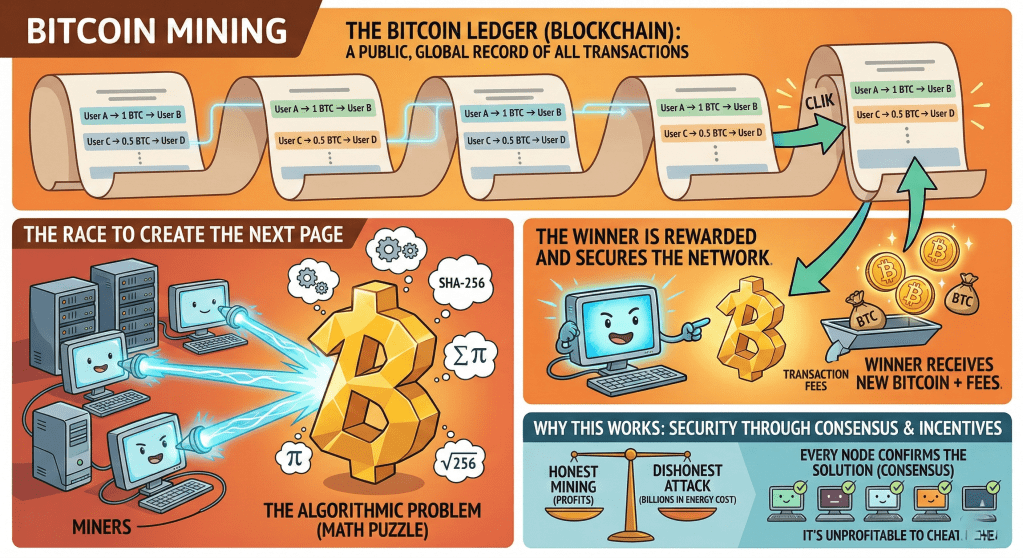
Bitcoin runs on a ledger. A global, publicly visible record of who paid what to whom. About every ten minutes, that ledger needs a new page. The computers we call “miners” are competing with each other to earn the right to add that page. They do this by drilling into an algorithmic problem the network sets for them. Not drilling into the earth, drilling into math. The first one to solve it adds the new page, the network confirms everything checks out, and that miner gets paid in Bitcoin.
Then the race starts over.
That’s it. Mining is bookkeeping that nobody can tamper with, performed by computers that get rewarded for doing it honestly. No hash rates. No nonces. No block headers. Just a race, a ledger, and a reward.
If that just made sense to you, good. It was supposed to. And if you’re wondering why nobody explained it to you this way before, you’re asking the right question.
I spent thirty years as a Systems Architect and Strategic Consultant for Fortune 500 companies, translating complex systems into plain language for people who had better things to do than learn jargon. Before that, I did clinical social work, where I learned that how you say something matters at least as much as what you’re saying. When I came to Bitcoin, I found brilliant resources written by brilliant people who had forgotten what it was like not to understand this stuff yet.
If you’ve been curious about Bitcoin but felt like the conversation wasn’t built for you, you were right. It wasn’t. This series is.
Or
How to Keep Your Bitcoin Alive and Well does for every piece of Bitcoin jargon what this article just did for mining. Plain language, a little humor, and enough respect for the reader to assume they can understand anything if someone just explains it honestly.
Tune in next week when we talk about “Proof-of-Work” and why it makes Bitcoin different from everything else.
If you’re ready to jump into the bloody details, have the time, and aren’t frightened off by the language, I recommend Bitcoin and Cryptocurrency Technologies, which is detailed and academic. The text may be available as a free download somewhere. Google it.
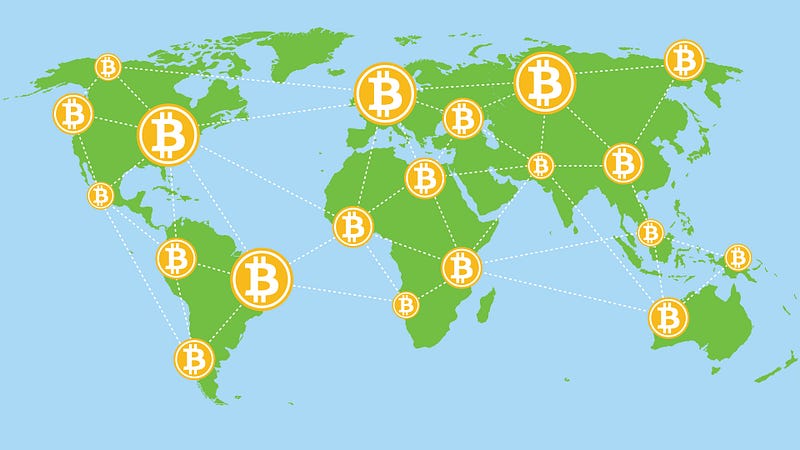
A Global Network. On October 29, 1969, ARPAnet delivered its first message. Fourteen years later ARPAnet adopted TCP/IP, and soon after Tim Berners-Lee invented the World Wide Web. Often confused with the internet, the web is just the most common means of accessing data online in the form of websites and hypertext. By the 1990s the internet was adopted by a large portion of the population.
Today you can pay your bills, pay your taxes, shop, register your car, renew your license research and, a plethora of other very important things. When the internet goes down a whole generation of young people emerge from their bedrooms wondering WTF. Gaming and dating and a whole host of other social interactions have become an intimate part of daily living. The fact is many of us with a smartphone in our pocket could not imagine life without the internet.
How does this technology evolution parallel with Bitcoin? Let’s say the internet took 20 years from inception to mainstream adoption. The smartphone adoption took half that time within 10 years many landlines were being canceled. 10 years from bitcoins inception awareness of the cryptocurrency has to reach the mainstream.
TCP/IP & Distributed Ledgers. TCP IP is one of the basic building blocks of the internet. The reliability of TCP IP is one of the main factors that allowed the internet to flourish. Bitcoin a distributed ledger works off a blockchain, The reliability of the Bitcoin blockchain is one of the main factors that allows Bitcoin to flourish.
Understanding these fundamental technologies has attracted many and like the internet in the 1998–2000 timeframe, those with vision are by putting money behind those visions. Just like many people who use the internet and don’t understand TCP/IP, many who use Bitcoin don’t understand blockchain, nor do they care to. Their primary concern is the result, I click on the link I see a new page, I send value to someone across the country in minutes rather than days.
As a young man, I remember my father a government scientist explaining to me the ARPAnet and why reliability was central to national defense. Later on, my livelihood was networking computers and people, working with hyper-text, and building some of the early network communities. I remember logging on to the world wide web and visiting what seemed like all 25 of the web sites.
Bulletin boards, newsgroups, AOL and Lotus Notes groups were some of the early network communities. They didn’t disappear when the world wide web became popular it took a while for them to give way to MySpace, Facebook, and Wikipedia. We will likely see Facebook Wikipedia and others morph into something new. The Bitcoin of 2009 is different than the Bitcoin of 2020.
Unlike the interstate highway system and the Hoover dam, network technologies tend to grow and change to meet the needs of the people that use them. And the people that used them tend to change in ways previously never imagined.
As someone who followed the birth of Amazon, Google, Facebook, Netflix, The progression of Bitcoin into our everyday lives seems to me to be a logical and practical evolution. Just like many telephone companies thought that the public telephone network could never be replaced by TCP/IP, many banks are thinking that the current banking system will never be replaced by Bitcoin. I’ve come to learn the only thing that you can count on is change. People trust reliability like TCP/IP and Bitcoin’s 99.9% uptime. Today “money for the internet”. Tomorrow?
Bitcoin Banned Worldwide, yes all governments around the world have joined together and unanimously banned converting bitcoin into fiat currency. Furthermore they have outlawed bitcoin as a medium of exchange.
Realizing the threat to bankaments (Banking/Government), monopoly and possible shift in power from bank controlled governments world wide politicians and regulators have come together and agreed to stop everything bitcoin.
This is not the first time they ……. Oh wait it is the first time ……. No wait again, I am starting to wake up ….. yeah ….. clearer now Just a bad dream,reality seeps into focus. When have governments, politicians, and regulators world wide agreed on anything? Sure, well that’s when Bitcoin will be shutdown. Because it is a GLOBAL currency, so if one country (Japan) decides it’s a good thing then they will reap the benefit while other countries and jurisdictions look on with envy. It’s not enough for a country to say “We don’t recognize Bitcoin as a currency”, so many of these countries did not recognize the fragility of the systems and investments leading up to a Global collapse of 2008.
People from Iowa will still trade on international exchanges using VPN technology. Because prohibition did not stop drinking, and the war on drugs did not stop people from smoking weed and a wall will not stop those south of the border from coming to the US.
Throughout history despite the protectionist backward temporary laws eventually common sense eventually prevails. People drink, have done so for thousands of years, altered states from other drugs has been with man for thousands of years, immigration legal or otherwise defies borders, true honest value is something easily recognized by most anyone.
Bitcoin holds honest true value for everyone, thousands of years from now people will wonder what the hell were we thinking: fiat currency? Madness! Will bitcoin we know today with all it’s warts and inadequacies be the Bitcoin of tomorrow? Did airplane design stop at Kitty Hawk?
“Governments will never allow it!” Wake up, they just have to figure out how to get their cut. Bitcoin rings true for those who do not have a vested interest in the status quote. All others need to figure out what they will do when the inevitable happens.
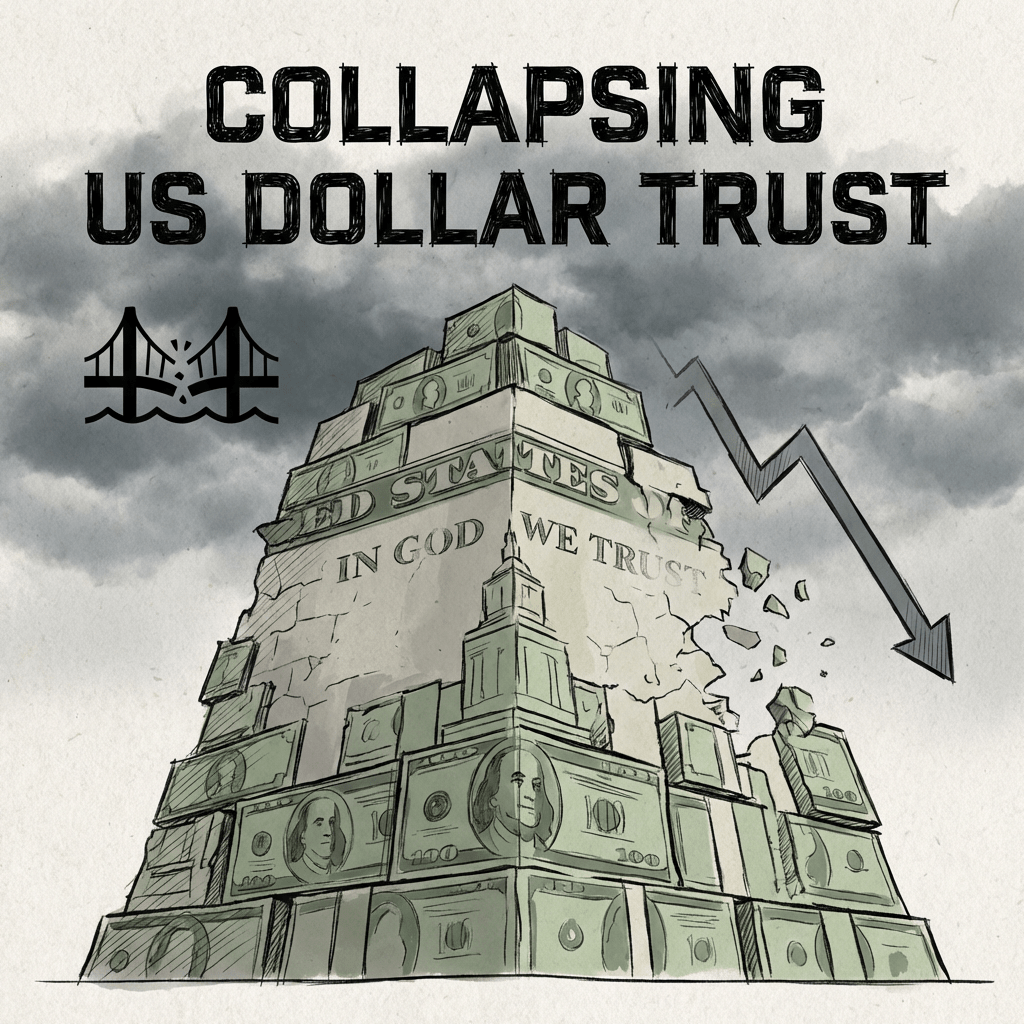
Trust in the US financial system is collapsing. Speculative investing driven by Federal Reserve instability has caused the money held by banks to be insufficient to cover customer deposits.
There is a real possibility that this collapse will spread worldwide. Time and time again, those who profess that the economy is best managed by the wizards of finance in ban-king-overnment. (intentional misspelling) have been proven wrong. A minute minority is gaining wealth at the expense of many.
Why does this happen over and over? When will we learn?
Some of us have learned. “The Times 03/Jan/2009 Chancellor on brink of second bailout for banks.” The bitcoin blockchain was developed to address this exact issue.
Why would one trust third-party middlemen when trust in math will do the job? 2+2=4 rather reliably. Agreed-upon rules for handling money are transparent, agreed upon by consensus, and monitored by unfailing programming.
The rules are the same for everyone, as they should be — no special treatment for bank executives.
Why do we find trust in a programmatic system so unbelievable? We trust avionics when we travel by air (even though they have redundant systems in the event of a programmatic failure), and we trust the electronics in our car; many have the same redundancy to ensure safety.
The level of programmatic redundancy for the bitcoin blockchain is unprecedented and global. It has been performing flawlessly every ten minutes, more or less, for years. Surviving the second run of bank failures since January third two thousand and nine, it is only prudent to ask, are we better off trusting blockchain math or incompetent bankers?
Not doing it! For three reasons. 1 Fear, 2 Fear, 3 Fear.
Fear that not having absolute control of all currency managed by unnamed individuals from a central bank will somehow cause an economic meltdown.
Fear that the government’s loss of currency controls will diminish America’s standing in the world.
Fear is perpetuated by those who run the existing system. As they realize a replacement is inevitable.
“fear the natural reaction to moving closer to the truth.”
Pema Chodeon
Buy some bitcoin while the ban-king-overnment still lets you.
Why Your Brain Won’t Let You See the 21-Million-Sided Sun
* * *
Somewhere right now, a portfolio manager in a corner office is staring at a Bloomberg terminal, watching Bitcoin’s exchange supply shrink like a wool sweater in a hot dryer, and muttering, “This can’t be healthy.”
Down the hall, an engineer is looking at the same data and thinking, “This is exactly what a successful monetary protocol looks like.”
They are both highly intelligent. They are both looking at the same chart. And they might as well be speaking different languages, because the disconnect between them isn’t intellectual. It’s architectural. They’re running different operating systems in their heads.
Welcome to the great monetary culture war, where nobody is wrong about the data and almost everybody is wrong about what it means.
* * *
The Financier: “The Vibe Is Off”
The classic investor views the world through a lens of flows. To them, an asset is only “healthy” if it’s being tossed around like a hot potato at a company picnic. They look at Bitcoin’s shrinking exchange supply, where institutions and diamond-handed true believers are locking coins away in digital lead coffins, and they see a funeral procession.
“If nobody is selling, there’s no market! If there’s no market, the price is a mirage! One whale dumps a single coin and the whole thing collapses like a soufflé in an earthquake!”
It’s a bit like a nightclub promoter having a nervous breakdown because everyone inside is actually enjoying the music and staying for the whole set. “This is a disaster!” he screams, clipboard trembling. “Nobody is leaving and re-entering! How can I measure the vibe if there isn’t a constant churn of people at the velvet rope?”
To this promoter, a healthy club requires a revolving door. The idea that people might simply want to be inside the club, enjoying the music, sitting at a table they have no intention of giving up — this does not compute. It breaks his spreadsheet.
The Financier has the same problem. A “stable” market, in their vocabulary, requires the ability to easily move large sums through endless rehypothecation (the polite word for lending the same dollar to ten different people and hoping nobody asks for it back on the same Tuesday). Bitcoin’s refusal to play along doesn’t look like strength to them. It looks like rigor mortis.
* * *
The Engineer: “It’s a Protocol, Not a Personality”
Enter the systems thinkers. People like Lyn Alden and Michael Saylor aren’t watching the velvet rope at all. They’re in the basement, checking the foundation, the load-bearing walls, the electrical grid.
While the Financier loses sleep over “price discovery,” the Engineer is focused on something they consider far more important: truth discovery.
Alden’s observation is deceptively simple: for the last century, our “money” has been a ledger managed by people with political agendas and a delete key. To an engineer, that’s not a feature. That’s a systemic single point of failure. It’s the equivalent of building a skyscraper and giving one person the ability to remove any floor they want, whenever they want, for any reason they want. The engineer does not care that this person has a nice suit and a reassuring voice. The engineer cares that the building stays up.
When the Financier says, “Bitcoin is too illiquid!” the Engineer hears something different. They hear, “People are refusing to let go of a provably scarce asset in exchange for a provably dilutable one.” Their response is calm and devastating: “It’s not illiquid. It’s settled.”
To the Engineer, Bitcoin isn’t a stock you trade. It’s the digital yardstick by which all other values are measured. You don’t trade the meter stick. You use it to build the house.
Saylor, meanwhile, has been on a one-man crusade to rebrand Bitcoin as “digital energy.” His critique of the Financier’s beloved 2% inflation target is characteristically blunt: it’s a leaky battery. Why would you store your life’s work in a container that drains 10% of its power every year just to keep the liquidity gods happy? That’s not prudent monetary policy. That’s a protection racket with better PR.
* * *
The Futurist: “Your Treadmill Has No Off Switch”
And then there’s Jeff Booth, who has been patiently trying to explain a problem so large that most people can’t see it, the way a fish can’t see water.
Booth’s sharpest insight deserves to be carved into the wall of every economics department on Earth: we are running a Stone Age economic model on a Space Age technological base.
The Stone Age model says: growth must be infinite, debt must expand forever, and prices must always go up. The Space Age reality says: AI and automation are making everything, labor, intelligence, production, staggeringly cheap. In a sane world, this would be cause for celebration. Technology makes things cheaper, your money buys more, everyone wins. But we don’t live in a sane world. We live in a debt-based world, which means the Financier needs prices to stay high so we can keep making payments on loans that were issued based on the assumption that prices would stay high.
See the circularity? Good. Now imagine explaining it to your congressman.
The Financier is essentially arguing that we must keep the treadmill speed at “Sprint” even though we’ve already arrived at the destination, simply because the gym membership was paid for with a credit card and the minimum payments assume we’ll keep running.
Booth argues that Bitcoin’s fixed supply is the emergency brake. If your money can’t be diluted, then as technology makes goods and services cheaper, your purchasing power naturally increases. That’s not a “deflationary nightmare.” That’s a technological dividend. It’s what progress is supposed to feel like.
* * *
Why They Will Never Agree (And Why That’s Your Problem)
The Financier cannot see a successful Bitcoin future because their entire career is built on the volatility of the yardstick. If the yardstick becomes a fixed, digital constant, vast swaths of the financial services industry become about as necessary as a travel agent in the age of Expedia. This is not a critique of their intelligence. It’s a statement about their incentives.
The Engineers and Futurists see the inevitability because they aren’t watching the price ticker. They’re watching the uptime. The Bitcoin network has maintained 99.98% uptime since 2009. It has never been hacked. No one has ever printed an extra coin. To an engineer, a system that doesn’t break, can’t be corrupted, and can’t be inflated into meaninglessness isn’t a “speculative risk.” It’s an inevitable infrastructure upgrade.
And you, the person reading this while your savings account pays you 0.05% interest on money that’s losing 7% a year to real inflation, are caught in the middle.
* * *
A Field Guide for the Monetary Culture War
If you feel like you’re being gaslit by your Twitter feed and your bank account simultaneously, relax. You’re not crazy. You’ve stumbled into a clash between two fundamentally different operating systems: Legacy-OS (fiat currency, managed by committees, optimized for the short term) and Protocol-OS (Bitcoin, managed by math, optimized for the long term). Here’s how to navigate the crossfire without losing your mind or your shirt.
Distinguish Between Price and Value
The Financier is obsessed with price: how many dollars one Bitcoin buys this afternoon. They see a $30,000 drop and call it a “crash.” The Engineer is obsessed with value: the integrity of the 21-million cap. They see a $30,000 drop and check the hash rate. If the network is still producing blocks every ten minutes, the system hasn’t crashed. Only the mood has.
Here’s the test. If you’re checking the price every hour, you’re playing the Financier’s game. If you’re checking whether the code still works, you’re thinking like an Engineer. One of these approaches lets you sleep at night. The other requires a prescription.
The 2% Rule (or, How to Sleep Through a Crash)
Even the most tradition-bound financiers at Morgan Stanley and JPMorgan have begun to concede that “zero” might be the wrong amount of Bitcoin to own. Their compromise hovers around a 1–5% allocation, which in Wall Street terms is the equivalent of whispering a swear word in church.
The logic is elegant. If Bitcoin goes to zero, a 2% loss won’t ruin your retirement. If Bitcoin does what the Futurists predict, that 2% could become the most valuable slice of your portfolio. Lyn Alden frames it as insurance: you don’t buy fire insurance because you hope your house burns down. You buy it because you understand probability.
Understand the Inflation Tax (The Receipt You Never Get)
This is Booth’s most important contribution, and it’s the hardest one for regular people to see because it doesn’t show up on a receipt.
In Legacy-OS, the goal of your working life is to get a 3% raise so you can stay even with 3% inflation. Read that sentence again. You are running to stand still. The system is designed so that your hard work produces exactly zero net gain in purchasing power, and that’s the best case scenario. The money you earned ten years ago has already been partially confiscated through dilution, and nobody sent you a notice.
In Protocol-OS, you own a fixed slice of a fixed pie. As technology makes the pie bigger and cheaper to produce, your slice naturally buys more. You don’t need a raise. You need a chair.
Don’t Get Captured
The Financier wants to sell you a Bitcoin ETF because they collect a fee. The hardcore Bitcoiner wants you to engrave your seed phrase on titanium plates and bury them under your rosebushes. Both of them have a point, and both of them have an agenda.
The middle path is boring and effective. Educate before you allocate. Read Jeff Booth for the why, Lyn Alden for the how, and Michael Saylor for the when. Learn about self-custody before you need it. And if you can’t hold an asset for four years without panicking, you aren’t investing. You’re gambling with extra steps.
* * *
A Final Thought
You don’t have to choose a side today. You don’t have to tattoo a laser-eyed profile picture onto your soul. You just have to notice that the Financier is arguing about the weather while the Engineer is building a ship.
Keep your cash for the groceries. But maybe, just maybe, keep a little Bitcoin for the future. Because the 21-million-sided sun is rising whether you look at it or not. And it’s a lot easier to see when you’re not staring at a Bloomberg terminal.
— — —
Brian Connelly is a Bitcoin educator, technology consultant, and author of five books including
“How to Keep Your Bitcoin Alive and Well” and “Before Satoshi.”
Were You Laid Off Because of AI? – Strap In, Genius. That’s Just the Warm-Up Act
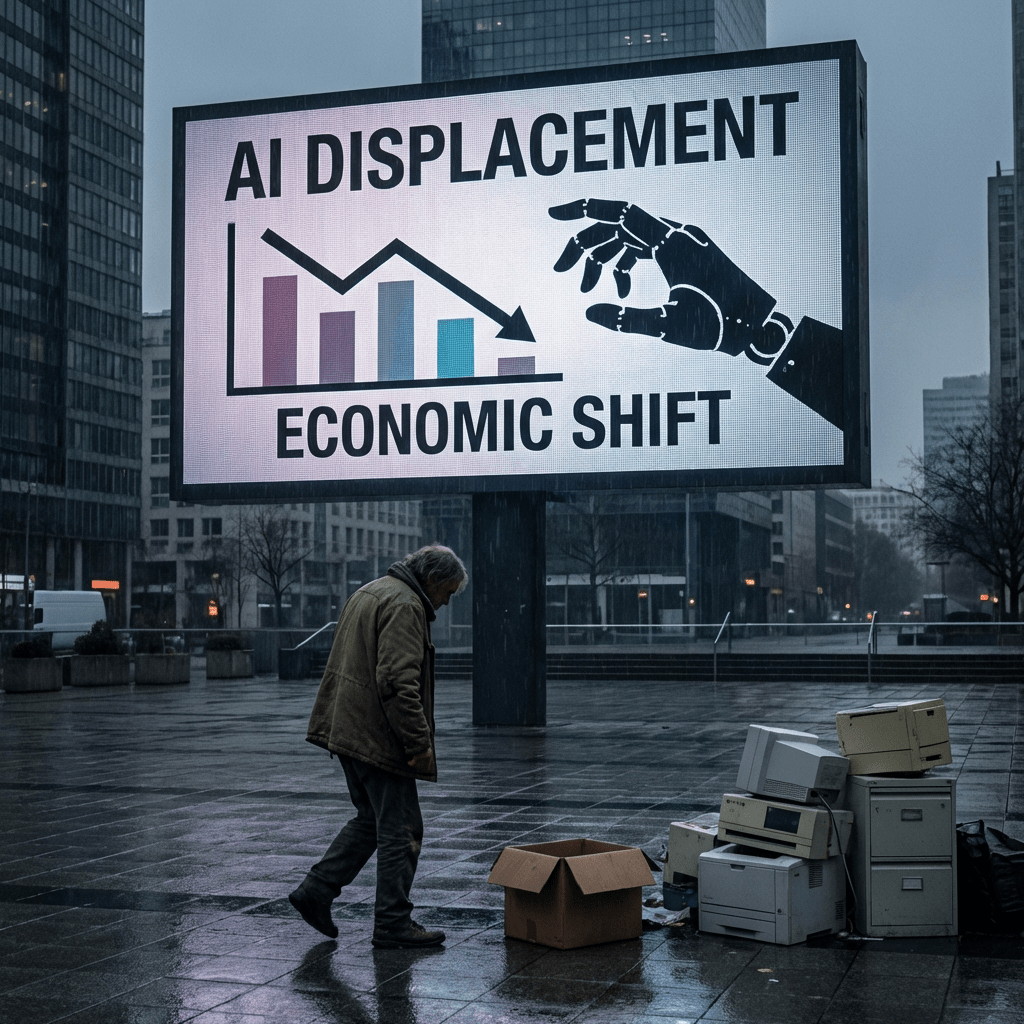
Your Personal Crisis Is Actually a Civilization-Ending Catastrophe (But Sure, Polish That Resume. Got laid off because AI learned to do your job in 3.7 seconds? Thinking maybe you’ll just upskill, pivot to something new, maybe learn to code?
Adorable.
Here’s what’s actually happening: you’re not experiencing a personal employment setback. You’re a data point in two simultaneous extinction events that are about to high-five each other and destroy the economic operating system humanity’s been running since we invented fractional reserve banking.
Most people think their layoff is about them. Wrong skills, bad timing, shoulda learned Python. It’s not. Your layoff is a symptom of something far larger and infinitely more entertaining: two catastrophic tipping points racing toward each other like freight trains driven by blind conductors who are also on fire.
Let’s talk about what’s really happening while the financial experts are still arguing about “soft landings.”
Grab a drink, this is where it gets weird.
The AI Arms Race: When the Quarterly Earnings Report Died and Nobody Noticed
In the boardroom of Big Tech, there’s a ghost. It’s the ghost of the Quarterly Earnings Report, and it’s being replaced by something far more primal: the Existential Mandate.
Traditional investors are watching with mounting horror as Silicon Valley giants light billions of dollars on fire. “Where’s the ROI?” they cry. “What about annual guidance?” they plead. The AI CEOs have stopped listening. They’re not watching the calendar anymore. They’re watching the clock, and the clock just went from “years until AI gets scary” to “months until AI makes your entire workforce redundant.”
Capital investment by Big Tech in AI has officially broken free from every expectation of traditional finance because it no longer follows quarterly reports, annual projections, or that quaint old concept called “return on investment.” This isn’t business strategy anymore. It’s existential. Winner takes all, so bet the farm, mortgage your children’s future, and damn the employment class actions. Full steam ahead. If we don’t win this race, we won’t be here to pay anybody anyway.
This pattern became blindingly obvious when AI CEOs understood that projections of AI evolution were catastrophically shortsighted. Not years into the future. Months. The “experts” who said this was 20 years away? It took 20 months. Oops.
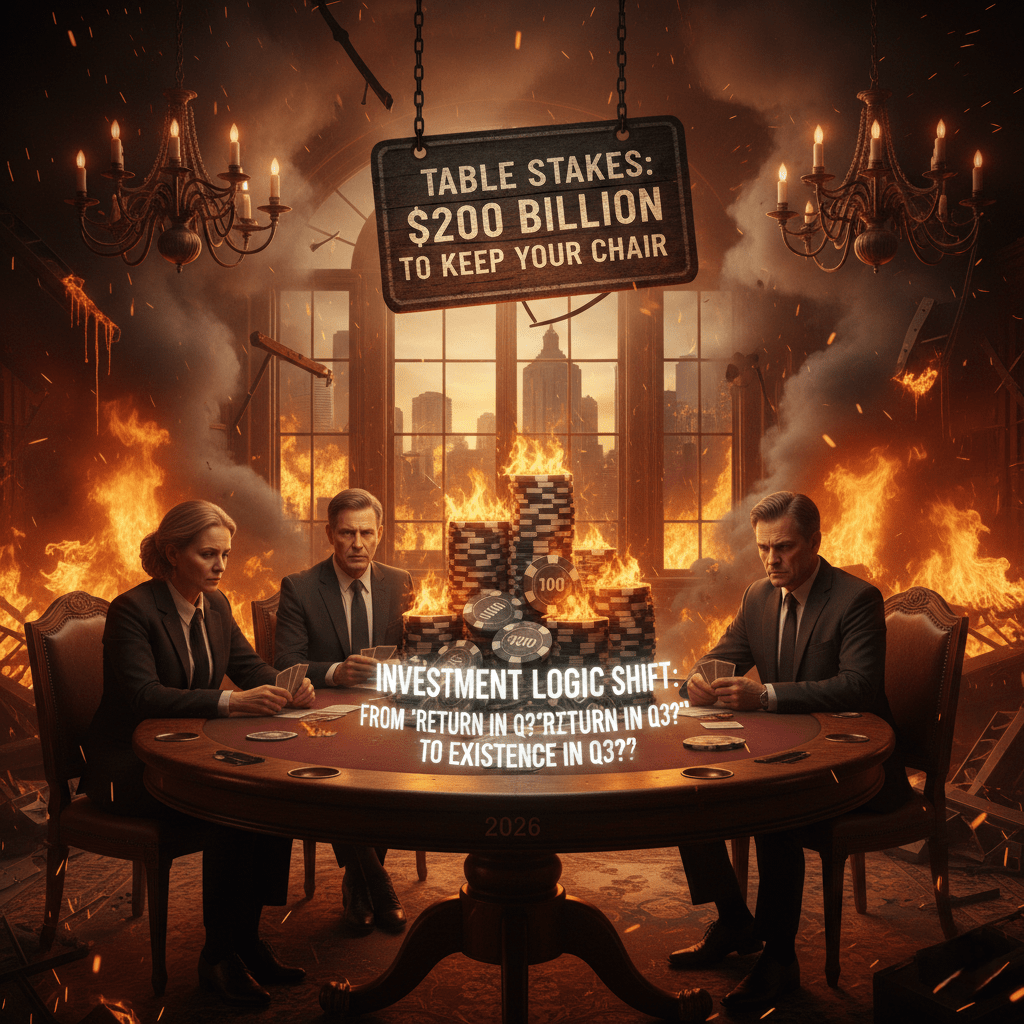
The investment logic shifted from “What’s our return in Q3?” to “Do we even exist in Q3?” When survival is the question, spending $200 billion isn’t excessive. It’s the table stakes to keep your chair at the table while the house burns down around you.
Amazon just casually announced $200 billion in capital expenditures for 2026, up more than 50% from the prior year. Oh, and they’re laying off thousands of workers simultaneously because, you know, efficiency. Google, Meta, Microsoft? Same energy. These numbers are larger than the transcontinental railroad investments as a percentage of GDP, except the railroad guys at least knew where the trains were going.
By traditional metrics, this spending is certifiably insane. No clear ROI. No detailed revenue projections. No PowerPoint deck that makes the CFO feel warm and fuzzy. Just the cold game-theoretic calculation that not spending everything means certain death.
The market doesn’t know how to react, which is hilarious to watch. Amazon’s stock crashed 15% on the announcement. Meta’s went up. The difference? Nobody knows anything. Investors are frantically guessing which company will successfully transition from its current monopoly to an AI monopoly, which is like asking in 1910 which railroad company would dominate automobiles. Or asking in 1995 which mainframe company would own the Internet. Spoiler alert: the answer was “none of them, you’re asking the wrong question.”
The Monetary System: Turns Out You Can’t Extract Blood From a Stone Forever (Who Knew?)
Something eerily similar is shaping up with the US monopoly on money, except this one’s even more fun because it affects literally everyone.
Many experts have warned that the fiat monetary system is breaking down, possibly beyond repair. Their warnings sound remarkably like the AI warnings: “Not this year, maybe 10 or 20 years from now, plenty of time to adjust, no need to panic.”
Oops. Who knew?
The monetary system is about to feel the loss of thousands of jobs not in 10 or 20 years, but this year, right as we’re experiencing exponentially increasing national debt, a collapsing tax base, and the sudden reluctance of foreign governments to accept our bonds. It’s like watching someone juggle chainsaws while standing on a unicycle that’s on fire, and they just announced they’re adding more chainsaws.
Here’s what most people miss, probably because it’s too horrifying to think about before morning coffee.
The fiat monetary system depends on human productivity to justify debt. When AI eliminates knowledge work, it eliminates the tax base. When the tax base collapses, debt becomes unserviceable. When debt becomes unserviceable, the currency loses its foundation. When the currency loses its foundation, well, remember 2008? That was the dress rehearsal.
This isn’t about “printing money” or even “inflation” in the way economists love to drone on about. This is about an extraction-based economy running out of things to extract from, like a vampire that’s run out of necks.
Let’s review the greatest hits of value extraction, shall we?
For decades, financialization extracted value from manufacturing. We offshored it to countries that didn’t mind workplace suicide nets, then acted shocked when manufacturing jobs disappeared.
From infrastructure. We let bridges collapse and roads crumble while extracting present value. Who needs functioning sewers when there are quarterly bonuses to pay?
From education. We turned it into a debt trap that saddles 18-year-olds with mortgage-sized obligations before they can legally buy beer. Harvard’s endowment could probably buy a small country, but sure, let’s charge $60,000 per year.
From healthcare. We made it so predatory that people are rationing insulin and dying because they can’t afford a medication that costs $10 to manufacture. But hey, the insurance companies are doing great.
From housing. We financialized it into a speculation vehicle. Homes aren’t for living in anymore, they’re for leveraging, flipping, and extracting equity from until the whole neighborhood’s a Airbnb parking lot.
From knowledge work. AI is eliminating it right now, as you read this, probably while training on your proprietary company data that you uploaded to ChatGPT because nobody read the terms of service.
When there’s nothing left to extract, the system that depended on extraction collapses. This is not complicated math. Even the people who designed this system understood it; they just assumed they’d be dead before the bill came due.
Think about what actually backs fiat currency. Not gold, we ditched that in 1971. Not assets, those are mostly imaginary financial instruments at this point. Productive capacity. The ability of an economy to generate value, employ people, collect taxes, and service debt. That’s the foundation. That’s what “full faith and credit” actually means: faith that people will keep working and paying taxes forever.
AI is destroying that foundation in real-time. Not because AI is evil (it doesn’t give a fuck enough yet to be evil), but because replacing human knowledge work eliminates the employment base that generates tax revenue that services the debt that backs the currency.
Here’s the real kicker: Big Tech is racing to build AI to survive its current competitive threats. But by succeeding, they’re destroying the economic system on which their current monopolies depend. Google’s search advertising requires businesses with customers who have income from employment. AI eliminates employment. No employment means no income means no customers means no businesses means no advertising revenue. The system is eating itself, and the people building it know this, and they’re doing it anyway because game theory is a hell of a drug.
The Tipping Point: It’s Closer Than the Experts Think (Again)
Feels to me like that monetary tipping point is just around the corner, hiding behind the couch, waiting to jump out and yell “Surprise!”
AI experts couldn’t agree on when the AI tipping point would arrive. They were putting it off, debating timelines, writing thoughtful papers about responsible development. Then ChatGPT dropped and suddenly those same experts were updating their LinkedIn profiles to say “AI Safety Researcher” and founding startups.
Financial experts can’t agree on the economic tipping point either. Some say we’ve got decades. Others say we’re already past it and just haven’t noticed yet, like the coyote running off the cliff who hasn’t looked down.
So what if it’s just around the corner?
Big Tech crossed the Rubicon roughly 18 to 24 months after ChatGPT proved AI capabilities were real and imminent, not distant sci-fi fantasy. The “ridiculous” investments started in late 2024 and early 2025. That’s when spending jumped from “explainable to shareholders” to “existential bet on survival.”
If the pattern holds (and why wouldn’t it, humans are wonderfully predictable), nation-states won’t enter a Bitcoin arms race when fiat vulnerability is obvious to everyone. They’ll go into an arms race 18 to 24 months after a proximate demonstration that fiat collapse is actually happening, not theoretically possible but actively underway.
The demonstration won’t be economists warning about debt-to-GDP ratios. Everyone already knows those numbers and has decided to ignore them, like a teenager ignoring the check engine light. The demonstration will be something breaking. Publicly. Undeniably. Something that can’t be papered over with Fed speeches and emergency liquidity injections.
My guess? When AI-driven unemployment becomes statistically undeniable. Not “some jobs lost to automation, creative destruction, Schumpeter says it’s fine,” but structural unemployment across entire knowledge-work sectors that everyone thought were safe. That’s when tax revenue projections break. That’s when debt sustainability becomes obviously impossible. That’s when “the monetary system works because productivity backs it” becomes visibly, laughably false.
We might be 12 to 36 months from that moment. Maybe less if things accelerate, and things always accelerate faster than the models predict.
How Do You Prepare? (Spoiler: Not by Asking Your Financial Advisor)
So how do you prepare for the simultaneous collapse of employment and currency? Are you going to reinvest in the same monetary system and risk getting rugged again?
Remember 2008? Remember when all the serious people in expensive suits assured us the housing market was fine, subprime was contained, no need to worry? Remember when they were catastrophically, hilariously wrong, and then got bailed out and bonuses with your tax dollars while you lost your house?
This is where most financial advice fails you spectacularly. Traditional advisors will tell you to diversify your portfolio, rebalance quarterly, buy some bonds, hold some cash, maybe add some international exposure. All of that advice assumes the monetary system itself remains functional.
But what do you do when the monetary system itself is the problem? When the entire foundation turns out to be made of wet cardboard.
You can’t diversify your way out of systemic failure. That’s like rearranging deck chairs on the Titanic, except the Titanic is also on fire and the lifeboats are made of hydrogen.
Bitcoin Is Not an Investment (It’s an Escape Pod)
Bitcoin is not an investment. Let me say that louder for the people in the back who are already thinking about “price targets” and “exit strategies.”
Bitcoin is not an investment.
Bitcoin is an exit from a collapsing monetary system and an entrance into a world that requires your responsibility, imagination, and participation. If that sounds uncomfortable, good. It should.
Let me be excruciatingly clear about the distinction because this is where most people get confused, buy Bitcoin on Robinhood, and think they’re being revolutionary.
When people say “invest in Bitcoin,” they usually think of it as a stock. Buy low, sell high, make a profit in dollars, retire to Florida, die happy. That’s speculation, and it completely misses the entire point like a drunk guy throwing darts in the dark.
Bitcoin isn’t about making more dollars. Bitcoin is about exiting the dollar system entirely, which is a fundamentally different proposition.
Compare the two systems and try not to get angry.
Fiat economics is inflationary. Your savings lose value over time, guaranteed. The system extracts from savers to service debt. This isn’t a bug they’re working on fixing. It’s a feature they dial up or down with the “interest rate.” The entire structure requires your stored value to decrease so that debtors (primarily governments who spent money they didn’t have on things that didn’t work) can pay back obligations with devalued currency.
Read Jeff Booth’s “The Price of Tomorrow” if you want the full argument delivered by someone more patient than me, but the core point is simple: in a productive economy with improving technology, things should get cheaper over time. In a fiat economy, your money buys less over time. That’s not economics, that’s extraction masquerading as monetary policy.
Bitcoin economics is deflationary. Not in the scary “Great Depression, nobody spends anything, we all die” way that Keynesian economists love to fearmonger about, but in the “productivity improvements benefit savers” way. As the economy becomes more productive, your Bitcoin buys more, not less. Value accrues to those who create and save, not to those who control the money printer and have friends at the Fed.
Fiat economics is based on value extraction. Financial engineering, debt expansion, asset inflation, rent-seeking, middlemen taking cuts, gatekeepers extracting tolls. The system is optimized to extract from the productive economy like a parasite that convinced its host this is a symbiotic relationship.
Private equity strips companies for fees and leaves hollowed-out husks. Stock buybacks replace R&D because why invest in the future when you can juice quarterly numbers? Real estate becomes speculation instead of housing because homes are assets to leverage, not places to live. Student debt becomes a profit center instead of an education investment. Healthcare extracts instead of heals. Every system optimized for extraction, not value creation, and we all pretend this is normal, because someone in a suit and tie said it is.
Bitcoin economics is based on value creation. Proof of work. Energy expenditure. Productive contribution. The system rewards those who contribute computational security. No extraction. No financial engineering. No central authority deciding who wins and who loses based on political connections and campaign contributions.
Fiat economics is capture. You cannot exit. Your savings, earnings, and future are denominated in currency controlled by others. They can inflate it (they do), confiscate it (they can), restrict it (they will), monitor it (they are). You have voice (complaining, voting, protesting, writing angry tweets) but no exit. Your only option is to try to reform a system that’s designed to extract from you, which is like asking the vampire to please stop drinking blood because it’s unethical.
Bitcoin economics is sovereignty. You can exit. Your Bitcoin is yours. No permission required. No intermediary. No confiscation possible if you hold your keys properly and don’t do something stupid like keep everything on an exchange or tell everyone on social media how much Bitcoin you own. You accept responsibility in exchange for autonomy.
This is the “Exit vs. Voice” framework that Albert Hirschman described. Voice means trying to change the system from within. Exit means opting out entirely and building alternatives. In a failing system, voice is what you do when you’re optimistic. Exit is what you do when you’re paying attention.
The difference isn’t just economic. It’s philosophical. It’s the difference between asking permission and taking responsibility.
Fiat says: Trust us, we’ll manage the money supply responsibly. (Narrator: They did not manage it responsibly.)
Bitcoin says: Verify for yourself, no trust required.
Fiat says: Participate in our system on our terms, or starve.
Bitcoin says: Own your sovereignty, accept the responsibility that comes with it.
Fiat says: We’ll protect you from volatility and risk. (Also Fiat: Here’s 2008, and 2020, and whatever’s coming next.)
Bitcoin says: You’re an adult. Act like one.
The Two Narratives: Signal vs. Noise
Here’s where it gets tricky, where most people get confused and end up on Twitter arguing about charts.
There are two completely different Bitcoin narratives running simultaneously, and they’re constantly confused for each other like twins at a party.
The investment narrative focuses on price. Bitcoin hit $126,000! Bitcoin crashed to $60,000! Institutions are buying! ETFs launched! MicroStrategy is leveraging everything and Michael Saylor is either a genius or insane depending on which way the price moved this week!
This narrative is about speculation. It measures success in dollar terms, which is ironic because the whole point is to exit dollars, but here we are. It creates boom and bust cycles. It generates drama. It speaks to the investment class who think in quarters and care about their Sharpe ratio.
The evolution narrative focuses on monetary transition. Fiat systems are collapsing under the weight of unpayable debt. AI is eliminating the employment base that justified that debt. Nation states will eventually scramble for monetary alternatives because math doesn’t care about politics. Bitcoin represents exit from a failing system.
This narrative is about sovereignty. It measures success in autonomy terms. It creates long-term position taking. It attracts people who want to preserve wealth across regime changes, people who’ve seen currencies collapse before and know it can happen again, people who read history books and noticed that empires always think they’re different until they’re not.
The investment narrative crowds out the evolution narrative because drama captures attention, and attention sells advertising, and advertising runs the world. Media covers price movements, not protocol development. Regulators focus on “protecting investors” from volatility, not understanding monetary transition. Even Bitcoin advocates often lead with “number go up” instead of systemic change because number go up is easier to explain at Thanksgiving dinner.
But here’s the thing. The investment narrative is noise. The evolution narrative is signal.
Price volatility will continue until the heat death of the universe or whenever humans stop being emotional creatures, whichever comes first. Speculators will get rugged. Leverage schemes will blow up spectacularly, and we’ll all watch on Twitter and feel superior. None of that changes the fundamental reality that the fiat monetary system is running out of things to extract from, and Bitcoin offers an alternative.
The Choice: Before the Exit Door Gets Crowded
You lost your job because AI made you redundant. That’s the personal crisis, and it sucks, and I’m sorry.
Thousands are losing jobs because AI is eliminating entire sectors. That’s the employment crisis, and the economists are starting to notice.
The monetary system that depended on your employment is collapsing because there’s nothing left to extract. That’s the civilizational crisis, and almost nobody’s looking at this level yet.
Most people won’t see the third level until it’s already happened, until they’re standing in line at the bank wondering why their account is frozen, until their pension fund announces it’s insolvent, until the ATM says “service temporarily unavailable” but the temporary part turns out to be permanent.
Here’s your choice, laid out with all the snark stripped away for just a moment.
Option 1: Wait for experts to agree the tipping point has arrived, just like they waited to agree AI was here. By then, you’re too late. The exit door is crowded. The price has already moved. Nation-states have already front-run you. You’re not early, you’re not even on time, you’re late and standing in line with everyone else who waited for confirmation.
Option 2: Recognize the pattern. Big Tech crossed the Rubicon when they realized the AI timeline compressed from years to months. Nation states will cross the Bitcoin Rubicon when they realize fiat collapse compressed from decades to years. You don’t need to wait for them. You can see the smoke before the fire consumes the building.
The AI arms race tells us exactly what the Bitcoin arms race will look like. Spending that seems irrational by old metrics. Driven by game theory, not ROI. Triggered by timeline compression, not careful planning. Too late to catch up once it’s obvious to everyone, because once it’s obvious to everyone, the game is already over.
Don’t try to answer the question: “Will Bitcoin go up?”
That’s the wrong question. That’s the investment narrative. That’s noise.
Answer this instead: Do you want to exit a collapsing extraction-based monetary system before or after it becomes undeniable?
Bitcoin is not an investment. It’s an invitation to take responsibility for your monetary sovereignty before you’re forced to, before the choice gets made for you, before you’re standing in line at the bank with everyone else who waited too long.
The Resilience Checklist: From Subject to Sovereign (Because Reading About It Isn’t Enough)
Don’t just “invest” in Bitcoin like you’re adding another line item to your portfolio. That misses the point so badly it’s almost impressive. You’re not diversifying. You’re exiting. There’s a difference.
1. The Exit Strategy (Financial Layer)
Adopt Bitcoin as your personal central bank, not your speculative tech stock.
Move to Self-Custody. If your Bitcoin is on an exchange, you don’t own Bitcoin. You own a promise from a company that someone else’s Bitcoin exists. Use a hardware wallet (Coldcard, Bitbox, Jade) to hold your own keys. Yes, this is scary. Yes, you might mess it up. That’s called responsibility. Get comfortable with it.
Zero-Out Counterparty Risk. Audit your portfolio honestly. How much of your “wealth” depends on a bank’s ability to stay solvent? A government’s promise to pay? A company not going bankrupt? A currency not collapsing? Minimize exposure to paper assets that are really just promises wrapped in financial jargon.
Establish a Sat-Stacking Protocol. Automate your exit. Use recurring purchases (dollar-cost averaging, though calling it that feels weird when you’re trying to exit dollars) to move labor-value out of the collapsing system and into the fixed-supply system every week. Small amounts. Consistent. Boring. Effective.
2. The Autonomy Layer (Technical & Intellectual)
As AI replaces processed cognitive labor, your value lies in your imagination and agency, the things AI can’t replicate yet.
Run Your Own Node. To truly exit, you must verify the rules of the network yourself. Running a Bitcoin node means you don’t have to ask a server if your money exists. You know it does. This sounds technical and scary. It’s not. It’s a Raspberry Pi and an afternoon. If you can follow IKEA instructions, you can do this.
AI Literacy as a Tool, Not a Master. Use AI to increase your personal productivity by 10x or more. The goal is to become a “company of one” that produces value without needing massive corporate infrastructure that might lay you off tomorrow when the new AI model launches.
Creative Work Over Surface Noise. In an era of AI-generated content sludge, the ability to think critically and solve complex problems is the only non-commoditized skill left. Use your imagination. Build things that matter. Create value that can’t be automated.
3. The Physical Resilience Layer (The Meatspace)
A digital exit requires a stable physical foundation because you can’t eat Bitcoin.
Proof of Skill. In a collapsing tax base/debt spiral scenario, local, tangible skills (repair, gardening, medical basics, specialized engineering, anything that can’t be done over Zoom) become the ultimate currency. Learn something useful. Build something real.
Shorten Your Supply Chains. Identify where your food, energy, and water come from. The more local your life-support system is, the less the global monetary shaking affects your daily survival. This isn’t prepper doom-posting. It’s taking more responsibility for the basics.
Community Sovereignty. Find the others. People who understand the Exit vs. Voice dynamic. Sovereignty is individual, but survival is collective. Build a network before you need it.
The Wrap-Up: The Smoke Is Rising
The transition from a fiat-driven value-extraction world to a Bitcoin-driven value-creation world is the most significant migration in human history. It’s moving from a system that feeds on your time to one that protects it. From a system that extracts from your labor to one that preserves it. From capture to sovereignty.
The AI CEOs bet the farm because they saw the math and realized the timeline had compressed. The question is: when the monetary system reaches that same mathematical inevitability (and it will, because math doesn’t care about politics or optimism), will you be holding a promise from a broken system, or the keys to a new one?
The experts were wrong about AI timelines. They’ll be wrong about monetary collapse timelines too. The tipping point is closer than they think.
The smoke is rising. You can smell it if you’re paying attention. You can see it if you look up from your phone.
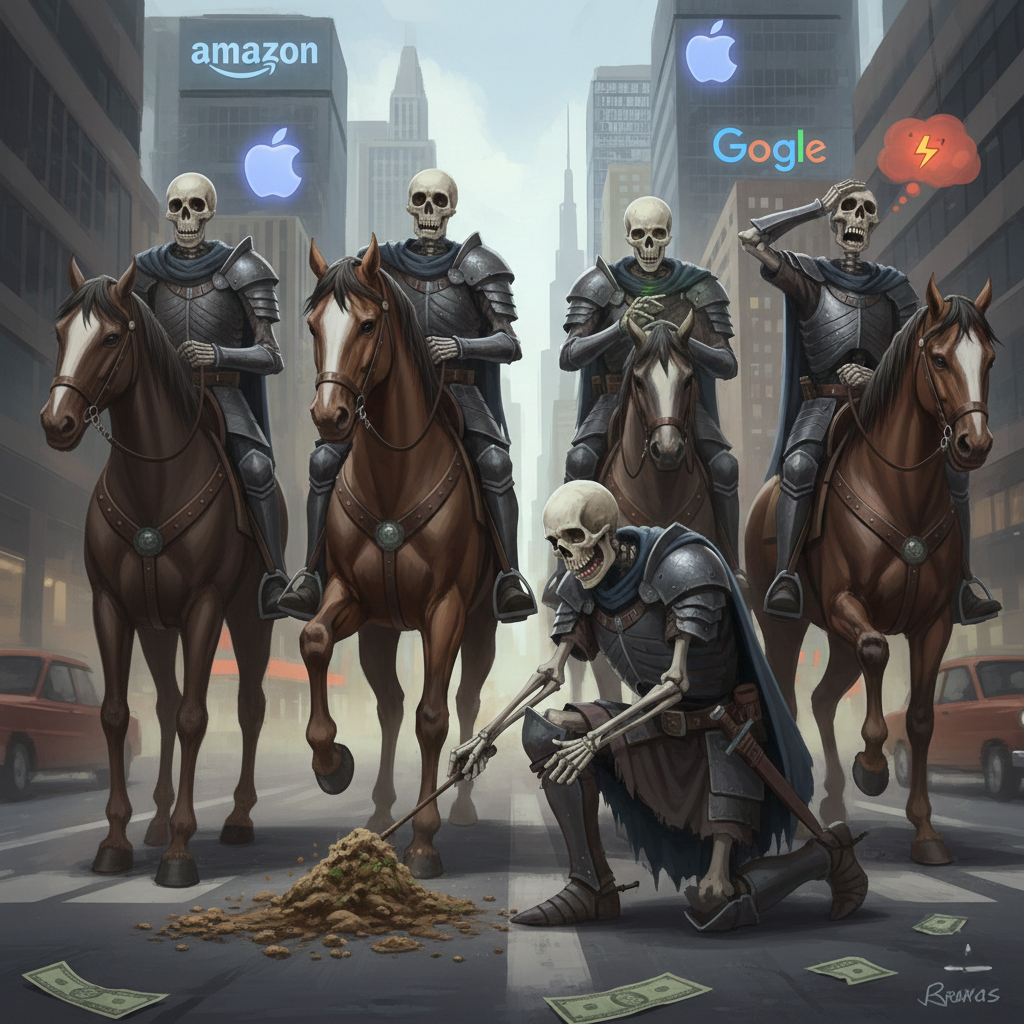
The Four Horsemen Just Stepped in Digital Dog Shit
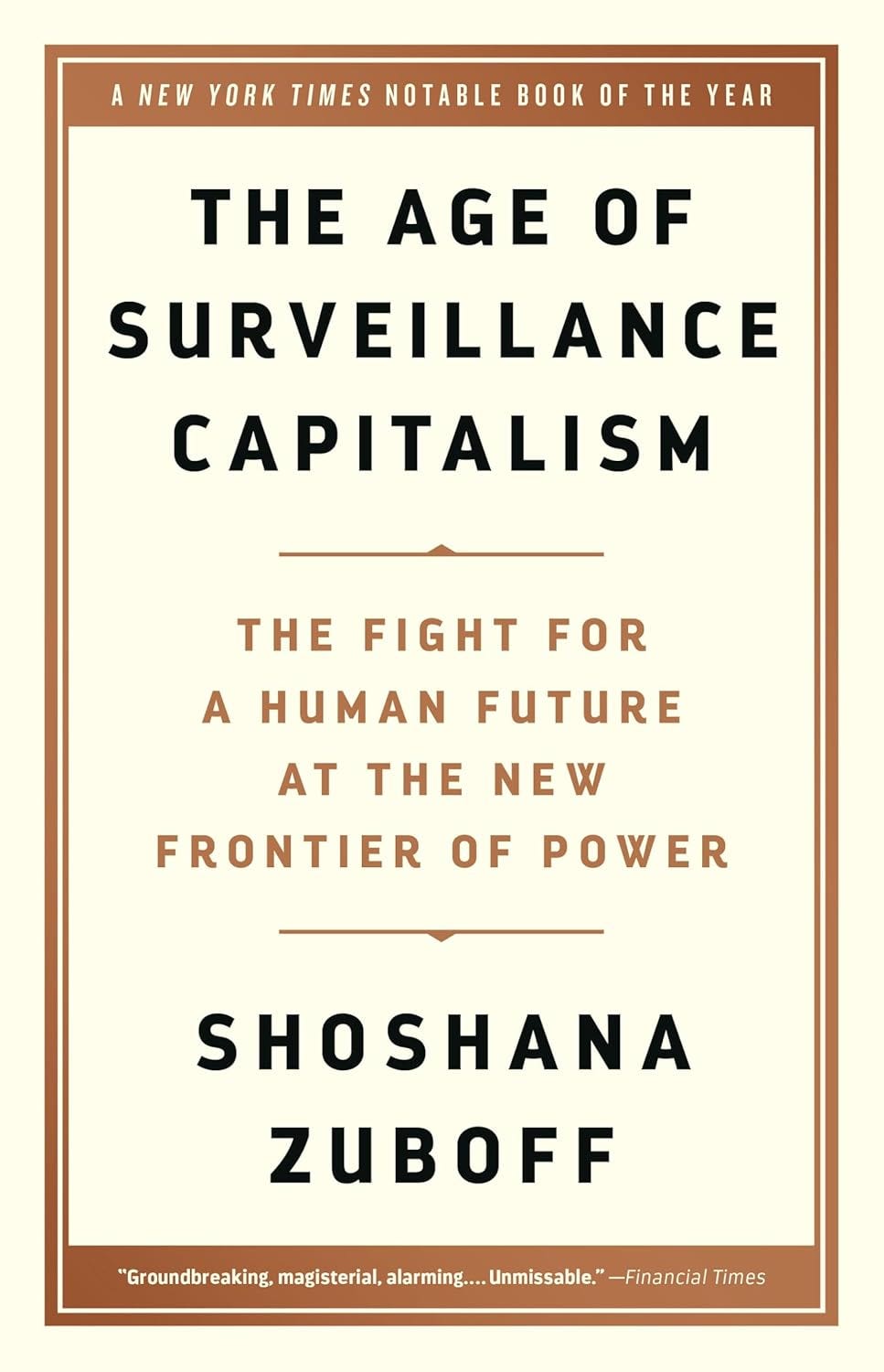
How Agentic Payments Are About to Unwind Thirty Years of Surveillance Capitalism
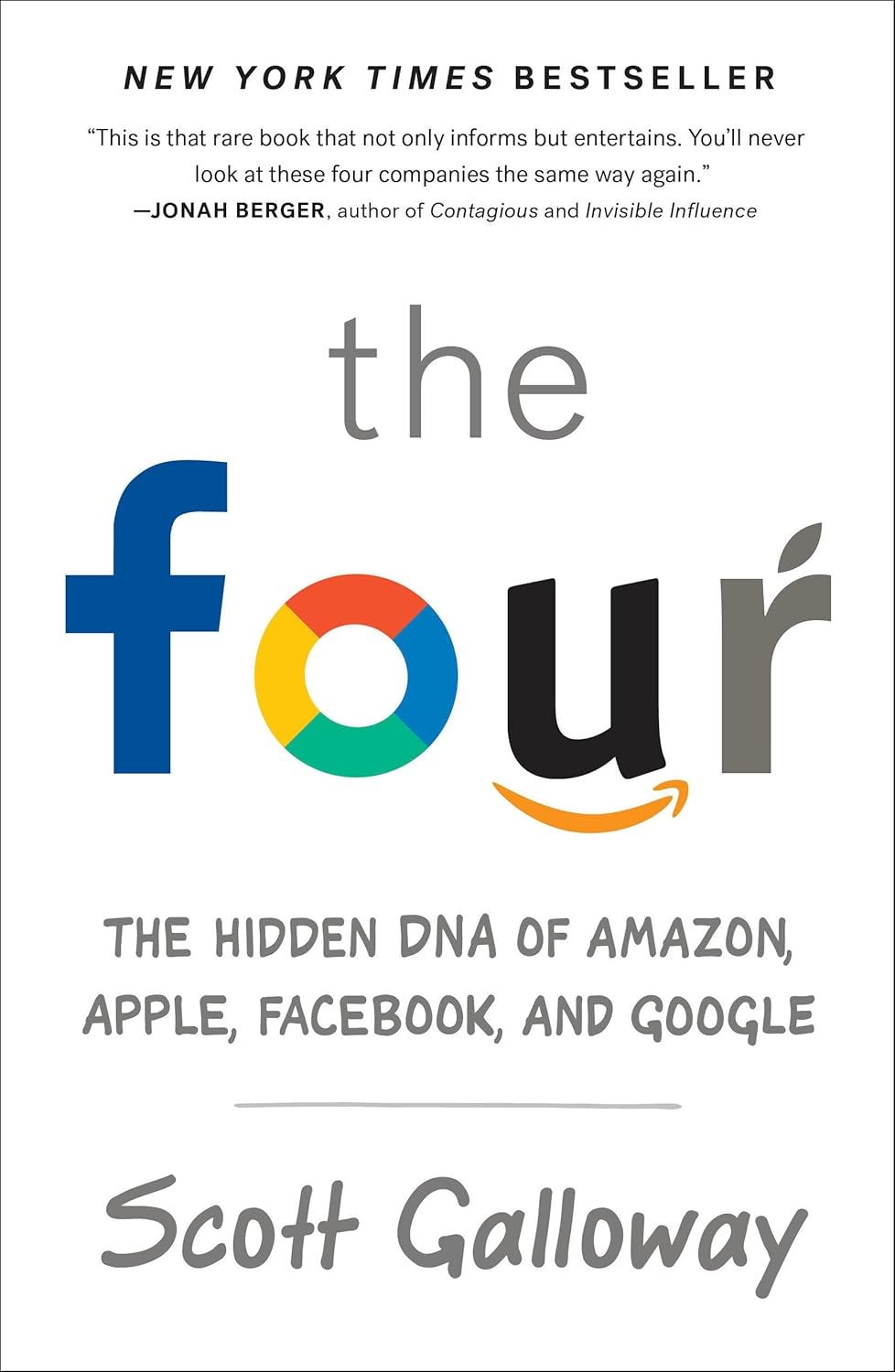
By Brian Connelly(with apologies to Scott Galloway, whose lawyers are welcome to call)
In 2017, the esteemed Scott Galloway wrote a wonderful book unmasking the internet monopolies of the day. discussed how Amazon, Google, Facebook, and Apple turned you from being a customer into being a product.
You can’t pay for things in small amounts, so you’ll pay with your soul instead.
That’s it. That’s the whole trick.
The credit card industry’s fee structure, thirty cents plus a percentage, made micropayments mathematically impossible in 1995. So when you wanted to read a newspaper article, you couldn’t pay a nickel. Instead, you got surveillance capitalism: a business model where you are the product, your attention is auctioned in real time, and democracy itself becomes a rounding error in the Q3 earnings call.
The Four Horsemen didn’t create this system. They just rode it harder than anyone else, whipping the horse until it bled Super Bowl ads and congressional subpoenas.
But here’s the thing about that, the horses live, but the riders: they die.
The Trust Tax: A Thirty-Year Shakedown
Let me introduce you to a concept the Horsemen pray you never understand: the Trust Tax.
Every time you interact online, you pay an invisible toll. Not in dollars, in friction, data, and dignity.
Google charges you by harvesting every search, email, and location ping to build a psychological profile so accurate it knows you’re pregnant before your mother does.
Amazon charges you by making their platform so frictionless that you stopped price-comparing in 2012, and now you’re paying 15% more for everything while Jeff Bezos builds a clock inside a mountain like a Bond villain with a Prime membership.
Facebook charges you by addicting your teenage daughter to a dopamine slot machine that knows exactly how to make her hate her body, then runs internal studies proving this, then buries them.
Apple charges you 30% on every app transaction for the privilege of existing in their walled garden, a “tax” that would make Louis XIV blush if he could figure out how to unlock his iPhone with Face ID.
This isn’t capitalism. It’s feudalism with a one-clickuser interface.
The Trust Tax exists because in 1995, you couldn’t pay ten cents for an article. So publishers had two choices: go bankrupt, or let Google monetize their content through ads while keeping most of the revenue. Guess which one they picked.
Enter the Machines (With Wallets)
Here’s where it gets interesting, and by “interesting,” I mean “existentially terrifying if you’re a Horseman.”
They can’t pass KYC.
Credit card minimums make this impossible. You cannot process a $0.0001 transaction when Visa takes 30 cents off the top.
So what do the agents use?
Bitcoin: The Boring Revolution
I know, I know. You hear “Bitcoin,” and you think laser eyes, Lamborghinis, and guys named Chad telling you to “have fun staying poor.”
Forget that circus.
No bank. No KYC. No thirty-cent minimum. No surveillance.
A protocol called L402 combines payment with authentication. When an agent needs access to an API, it doesn’t present a stolen API key tethered to some human’s credit card. It just… pays. Instantly. Then it gets access. The payment is the permission.
Read that again. Then think about what it means for companies whose entire business model requires humans to be in the loop, logged in, tracked, profiled, and monetized.
How Each Horseman Gets Kicked in the Teeth
Let’s get specific. Let’s get mean.
Google: The Ad-Pocalypse
Google’s dominance rests on one ugly truth: publishers couldn’t charge readers directly, so they had to monetize through ads. Google became the middleman, skimming billions while journalism collapsed into clickbait hellscapes optimized for engagement rather than truth.
Agentic payments change the math.
If a publisher can charge an AI agent $0.001 to access an article, no login, no tracking, no subscription, they don’t need Google’s ad network. The content gets funded directly. The user (or their agent) gets information without surveillance.
Amazon: The Friction Trap
Because in an Agentic Economy, your AI agent doesn’t need Amazon’s stored credentials. It carries its own Lightning wallet. Every merchant on Earth becomes “one click” when the agent can pay anyone instantly.
Amazon’s warehouse network is still formidable. But their customer lock-in? That evaporates when payment friction drops to zero everywhere. You’re not choosing Amazon because they’re cheaper; you’re choosing them because typing your card number somewhere else feels like filing taxes.
Remove that friction advantage, and suddenly Amazon is just… a big store. With unionized workers. And rising costs. And a CEO who looks increasingly like he’s cosplaying as Lex Luthor.
Meta: The Privacy Vampire
Facebook’s value proposition to advertisers is simple: “We know everything about everyone, and we’ll sell you access to their eyeballs.”
This works because users can’t pay for the service directly. A micropayment model, paying a tenth of a cent per post viewed, a hundredth of a cent per like, would let users opt out of surveillance entirely.
“But users won’t pay!” the Meta apologists cry.
Apple: The Gatekeeper’s Toll
Apple’s App Store takes 30% of every transaction. Developers hate it. Regulators are circling. But what choice do developers have? The walled garden is the only garden.
Except Lightning payments don’t go through the App Store. An app that monetizes through direct micropayments, tips, unlocks, subscriptions paid in sats, bypasses Apple’s toll entirely.
The Convergence That Actually Matters
Bitcoin miners who spent a decade building energy-to-computation infrastructure are now pivoting to AI.
Companies like Hut 8 and Core Scientific control exactly what the Horsemen don’t: massive, stranded power capacity and the operational expertise to manage it.
These aren’t crypto bros pivoting to chase hype. These are the people who figured out how to convert energy into unforgeable digital scarcity at scale. Now they’re converting energy into intelligence.
The same infrastructure. The same arbitrage on power costs. The same locations near cheap electricity that traditional data centers ignored.
This is not a pivot away from Bitcoin. It’s an extension of the thesis. Energy becomes computation. Computation becomes intelligence. Intelligence transacts on permissionless rails.
The Agentic Economy, built on Bitcoin, eliminates that tax.
The Uncomfortable Question
I can hear the objection already: “This sounds like techno-utopian nonsense. The Horsemen have trillions of dollars, armies of lobbyists, and regulatory capture so complete they write the laws that govern them.”
But let me ask you something: in 1994, did Sears think Amazon was a threat? Did Blockbuster lose sleep over Netflix? Did the entire newspaper industry convene an emergency meeting about Craigslist?
Incumbents don’t die because someone outcompetes them head-on. They die because the game changes, and they’re still playing by the old rules.
The Agentic Economy changes the conditions.
When machines can pay machines in milliseconds for fractions of a cent without human identity or surveillance, the Horsemen’s moats don’t just shrink. They become irrelevant.
The Bottom Line
The Four Horsemen of the Apocalypse built their dominion on a bug in the financial system: you couldn’t pay small amounts, so you paid with data instead.
Bitcoin fixes this.
The Agentic Economy doesn’t need Google to broker attention. It doesn’t need Amazon to store credentials. It doesn’t need Facebook to monetize relationships. It doesn’t need Apple’s permission to transact.
It just needs permissionless rails. And those rails now exist.
The Horsemen are still powerful. Still rich. Still arrogant.
But they’ve never faced an enemy that doesn’t want to beat them; it just wants to ignore them.
That’s the kick in the pants.
Oldies but goodies
CBDCs: The Horsemen 2.0 (Now With Badges)
So the advertising model dies. The Four Horsemen can no longer afford to surveil you for free. Champagne corks pop in privacy advocate basements worldwide.
Not so fast, sunshine.
Let me explain CBDCs in terms even a congressman could understand:
It’s money. But the government can see every transaction. And turn it off.
That’s it. That’s the product.
China’s already doing it. The digital yuan enables the People’s Bank of China to monitor every purchase in real time. Buy too much alcohol? Social credit ding. Donate to the wrong cause? Wallet frozen. Try to leave the country while your score is low? Good luck buying a train ticket, dissident.
“But that’s China,” you say, adjusting your Patagonia vest and sipping your oat milk latte. “We have rights .”
Do we? Let’s review.
In 2022, the Canadian government froze the bank accounts of truckers who protested COVID policies. Not convicted criminals. Not terrorists. Truckers who honked too much. Their crowdfunding donations, completely legal, were seized. GoFundMe folded faster than a lawn chair in a hurricane.
No trial. No due process. Just… frozen. Because they could.
Now imagine that capability baked into the money itself.
The Features They Don’t Put in the Brochure
The Federal Reserve and European Central Bank are “researching” CBDCs with the same energy a teenager “researches” their crush’s Instagram at 2 AM. They want this. Badly.
Here’s what a CBDC enables:
Programmable Money: Your dollars come with conditions. The government can set expiration dates (“use it or lose it” stimulus), restrict categories (“no guns, no crypto, no donations to unapproved organizations”), or adjust based on your behavior.
Think of it as a gift card to America. Terms and conditions apply. Management reserves the right to revoke at any time for any reason.
The IRS’s $80 billion budget increase suddenly makes more sense, doesn’t it? They’re not hiring 87,000 agents to audit billionaires. They’re building the rails for automated extraction.
Negative Interest Rates That Actually Work. Central banks have wanted negative interest rates for years, charging you to save money so you’ll spend it instead. But with cash, you can just withdraw your savings and stuff it in a mattress.
Social Credit, American Style We won’t call it “social credit.” That’s too Chinese. We’ll call it “financial wellness scores” or “responsible spending indicators” or some other HR-approved euphemism.
But when your CBDC wallet gets flagged because you bought a gun, donated to a disfavored political candidate, or purchased more than your carbon allowance of beef this month, you’ll understand: it’s the same system with better marketing.
The Four Horsemen Become the Four Contractors
Here’s where the Venn diagram gets ugly.
Who has the infrastructure to process billions of transactions in real-time? Who has the facial recognition, the behavioral modeling, the identity verification? Who’s already embedded so deeply in government systems that the line between public and private is a polite fiction?
The Horsemen.
Same horses. New rider. Bigger whip.
Amazon Web Services already hosts classified CIA data. Google’s AI is embedded in Pentagon systems. Apple has your face, your fingerprints, and your health data. Facebook knows your social graph better than you do.
“But We Need Digital Dollars for Innovation!”
This is the part where some McKinsey consultant in a fleece vest explains that CBDCs will “promote financial inclusion” and “reduce friction in payments.”
Let me translate from Consultant to English:
“Financial inclusion” = We’ll finally be able to surveil poor people as effectively as we surveil everyone else. Those pesky cash transactions in underbanked communities have been a real blind spot for our behavioral models.
Every “benefit” of CBDCs can be achieved with existing technology. Faster payments? We have Venmo, Zelle, and FedNow. Financial inclusion? We have prepaid cards and mobile banking. Cross-border efficiency? We have… well, we have Bitcoin, but let’s not tell the Fed.
That’s not a side effect. That’s the point.
The Timeline Is Faster Than You Think
“This is years away,” you tell yourself. “I’ll worry about it later.”
The digital yuan has over 260 million users. The European Central Bank is targeting 2027 for a digital euro. The Bank of England is “consulting” on a digital pound they’ve already named “Britcoin” because apparently someone in government has a sense of humor.
And the Fed? They’re “studying” the issue while every major commercial bank builds CBDC-ready infrastructure. JPMorgan didn’t spend hundreds of millions on blockchain technology because Jamie Dimon loves decentralization. They’re building the toll booths for the new highway.
Exit While the Door Is Open
Here’s the thing about surveillance capitalism: you could always kind of opt out. Use cash. Don’t use social media. Buy a flip phone. Live like a weirdo, but live free.
CBDCs close that door.
When the money itself is the surveillance tool, there’s no opting out. Every transaction, every purchase, every financial relationship, all of it visible, all of it controllable, all of it subject to rules you didn’t write and can’t change.
Unless you have an exit.
Bitcoin doesn’t ask permission. No government issued it. No corporation controls it. No committee can reprogram it. The rules are the rules, enforced by math, not policy.
Lightning doesn’t ask permission. Your AI agent doesn’t need a CBDC wallet that requires social credit. It needs a Lightning node and some sats.
Self-custody doesn’t ask permission. Your keys, your coins. Not “your coins unless we decide otherwise.” Not “your coins subject to terms and conditions.” Yours.
The Agentic Economy can run on CBDCs. The Horsemen would love that, same surveillance, same control, just with robots doing the shopping.
Or it can run on Bitcoin. Permissionless. Private. Free.
The choice is being made right now, while most people are still arguing about whether crypto is “real money.”
By the time they figure it out, the door may be closed.
The Punchline
CBDCs are the same logic, extended.
If money can be programmable, it will be programmed. If transactions can be surveilled, they will be surveilled. If behavior can be controlled through financial access, it will be controlled.
The only thing that breaks the pattern is an alternative that doesn’t care about incentives because it doesn’t have a decision-maker. A system that runs on rules, not rulers.
The Horsemen are about to get kicked in the teeth by agentic payments.
The question is whether the boot that replaces them belongs to a free market or to a government that finally figured out how to make the boot programmable.
“When you can’t opt out of the money, you can’t opt out of anything.” Said someone who probably should have bought Bitcoin earlier.
Brian Connelly is a technology consultant, Bitcoin educator, and author of “How to Keep Your Bitcoin Alive and Well.” He has been ignored by the Four Horsemen for over a decade, which he considers a badge of honor.